Why the Best Digital Assets Monetize Relationships (Not Just Impressions)


Blog


 The Exit Podcast
Audience depth, not pageview volume, is what separates the digital businesses commanding premium multiples on the secondary market from the ones that don’t. The shift is already reshaping how acquirers value digital assets — and how operators should be building.
This article explores why first-party data, audience retention, and relationship monetization are becoming critical drivers of higher revenue, stronger defensibility, and premium acquisition multiples for online businesses.
Looking to grow revenue and increase your digital asset’s value? Connect with Ezoic through Flippa Partner Directory to unlock premium ad monetization, first-party data solutions, and insights to help optimize and scale your business.

Walk a sophisticated buyer through any digital asset acquisition and you can predict where they will spend the most time. It will not be the pageview chart. It will be the audience –
Pageviews are inventory. Inventory gets rented. The asset a buyer is actually paying for in 2026 is the audience underneath it and increasingly, that’s where multiples expand or compress.
This shift didn’t happen overnight. It is the byproduct of a programmatic market that has spent five years walking down the value of unauthenticated impressions and walking up the value of addressable, owned-audience inventory.
For digital business owners thinking about yield, durability, or eventual exit, understanding why that’s happening, and what to do about it, has stopped being optional.
The conventional model of digital business monetization treats every page load as a revenue event:
For two decades that worked because the buy-side could target and measure those impressions reliably through third-party cookies and device IDs.
That signal infrastructure has been degrading on a curve. Safari has blocked third-party cookies by default since 2020. Firefox followed. Chrome’s policy has shifted multiple times, but the practical effect on the buy-side has been the same throughout: the share of inventory that buyers can target, frequency-cap, and attribute against a known user has been falling for years, and demand-side platforms have priced that uncertainty in.
A second pressure has accelerated the trend: Buyers are aggressively pruning low-quality supply paths.
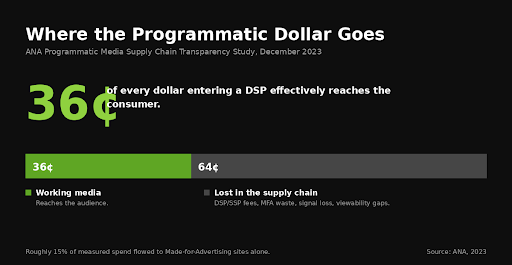
The Association of National Advertisers’Programmatic Media Supply Chain Transparency Study found that only 36 cents of every dollar entering a demand-side platform effectively reached the consumer, with roughly 15% of measured spend flowing to Made-for-Advertising sites.
SPO (supply path optimization) initiatives, direct deals, and curated marketplaces have absorbed budgets that used to flow indiscriminately. The premium goes to inventory that is verifiable, targetable, and attached to a known audience signal. Everything else gets priced like commodity supply, because that’s what it is.
Both forces point the same direction. A digital asset whose monetization model is “render impressions and collect CPMs” sits on a yield curve bending downward independent of how well the site is run. The math is simple, and it applies regardless of how much SEO traffic the asset has captured.
The reframe is straightforward but the operational implications are not.
Relationship monetization is the practice of building, owning, and activating a direct connection with the audience and then attaching that connection to every layer of the business, including the ad layer. In practical terms, that means:
The economic logic compounds. Boston Consulting Group’s joint research with Google, Responsible Marketing With First-Party Data, found that brands with mature first-party data activation see 1.5x to 2.9x higher revenue uplift on a single ad placement compared with weaker setups.
The same audience also reduces frequency waste, improves attribution, and creates durable cohorts that can be retargeted across owned channels at near-zero marginal cost. None of that is available to an asset that knows its visitors only as anonymous IPs.
Ezoic’s own research on why first-party data pays more in 2025 and beyond tracks the same dynamic at the publisher level: CPMs and EPMVs separate dramatically between identified and unidentified inventory, and the gap is widening.
For Flippa buyers, the relationship layer is the cleanest form of defensibility a digital business can carry into a transaction.
Three reasons it travels well:
A site whose value is “we rank #1 for X” is selling an SEO position. A site whose value is “we have 400,000 known, segmented, opted-in subscribers who return monthly” is selling a business. The first is rented surface area. The second is the underlying business. Audience-driven assets carry through ownership transitions; ranking-driven ones often don’t.
This shows up in due diligence. Buyers ask for first-party data lists. They ask for return visitor cohorts. They ask for retention curves. They ask how much of the audience the asset can recognize and re-engage on its own (e.g. through email, identity, return visit signals, and direct retention loops), alongside paid acquisition.
The answer to these questions moves multiples – sometimes dramatically.
For sellers thinking about exit, and for operators thinking about durable yield in the meantime, the playbook is consistent.
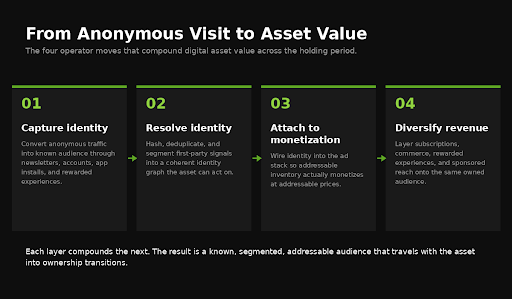
Capture identity at the surface. Every meaningful interaction is a chance to convert anonymous traffic into a known audience. That means a newsletter signup with a real value proposition, not an interstitial. An account system if the use case warrants it. Gated premium content where the friction makes sense. Rewarded experiences for app or video properties. The goal is to move as much traffic as possible from “unknown visitor” to “recognized identity” without breaking the experience that drove the visit in the first place. Recent industry data has shown domains implementing identity solutions through email hashing seeing roughly a 2x increase in ad fill rates, with material CPM lift on mobile.
Resolve identity into a usable graph. A list of email addresses sitting in a CRM is not, by itself, a monetizable identity layer. The list has to be hashed, deduplicated, attached to on-site behavior, and made available — under proper consent — to the systems that monetize the inventory. This is the work that separates digital businesses with “an email list” from digital businesses with a usable first-party identity strategy.
Attach identity to monetization. The yield uplift from first-party data only materializes when the data is actually wired into the ad stack. Programmatic deals — PMPs, curated marketplaces, identity-enabled open auctions — pay materially more for inventory that arrives with a first-party signal attached. Operators leaving that connection unmade are, in effect, selling addressable inventory at non-addressable prices. Properly wired identity also fixes a problem most digital businesses don’t realize is costing them: frequency capping breaks down in cookieless environments, and identity is what restores it. When frequency control comes back, ad fill performance and pacing efficiency come back with it.
Diversify monetization beyond display. A digital asset whose only revenue line is open-exchange display advertising is, by definition, exposed to every dynamic described above. The audience-relationship layer unlocks monetization surfaces that compound: subscription products, commerce, affiliate programs structured around verified intent, rewarded ad experiences for engaged users, sponsored content that carries reach guarantees the buyer can verify. A buyer evaluating an asset with three or four monetization surfaces tied to the same audience is paying for a more defensible business than one with a single-stream model. Buyers know this. So do their lenders.
Operators in the middle of this transition often find the gap between “we know what we should be doing” and “we have the infrastructure to do it” is bigger than expected. The identity layer, the consent management, the audience segmentation, and the connection to a monetization system that actually pays for first-party signals are not trivial pieces to assemble individually, and the value of any one of them compounds only when they’re all connected.
That connective layer is what ezID is built to provide. It takes the first-party signals a digital business already collects like logged-in users, newsletter subscribers, hashed emails, app identifiers, and resolves them into an addressable identity layer that travels with the inventory into the bidstream as known audience.
What separates ezID from a generic identity wrapper is the proprietary identity graph Ezoic has built in-house. Rather than relying on a single ID provider, ezID layers Ezoic’s own graph technology on top of partnerships with the major deterministic and probabilistic ID providers across the market. The practical effect is meaningfully higher match coverage on the same underlying traffic.

For operators, that translates into a real yield separation between identified and unidentified traffic, with CPMs and EPMV (earnings per thousand visitors) moving meaningfully higher when audience signals are attached. For an eventual buyer, the same infrastructure translates into something more strategic: an audience asset they can recognize, segment, and continue to monetize from day one of operation, rather than a traffic source they have to relearn from scratch.
The audience is the asset. Identity is what makes it addressable. The infrastructure to resolve, hold, and activate that identity is what increasingly separates the digital businesses commanding premium multiples from the ones still selling impressions.
For sellers, the work to build relationship monetization into a digital asset doesn’t pay off only at exit. It pays off in compounding yield, lower frequency waste, higher LTV per visitor, and more durable revenue across the holding period. It also happens to be the single largest lever a seller can pull on multiple expansion when they are ready to transact.
For buyers, the question to ask of any digital asset on the marketplace has shifted. “How much traffic does it get?” was the right question a decade ago. The right question today is “how much of that traffic is known, returnable, and addressable through owned channels?” That line separates an asset that will keep paying down its multiple from one that won’t.
The most valuable digital businesses on the secondary market increasingly share one quality more than scale: their audience is recognizable to the asset itself. A known audience compounds value across every monetization layer the operator runs and every demand source it sits in front of. Building toward that on either side of the transaction is where the next decade of digital asset value is going to be made.

Hear from business owners and entrepreneurs who have bought and sold online businesses on Flippa.

Search our knowledge base for answers to common questions.