How to sell an Amazon FBA business: 2026 guide


Blog


 The Exit Podcast
The market for selling an Ecommerce business is strong, with 123K active buyers on Flippa in H1 2026, up 18% for the same period last year.
But those buyers are coming into the market more selective than before, looking for evidence of strong, defensible brands with clean financials and clear growth potential.
That’s reflected in how they’re researching acquisitions. The fastest-growing search term on Flippa in H1 was ‘recently sold’, suggesting buyers are looking for comparable transactions before making an offer. Amazon businesses are also attracting interest, with ‘Amazon’ searched 4,174 times on Flippa in the first half of 2026.
For Amazon FBA business owners, understanding what buyers are looking for – and how similar businesses are being valued and sold – can help set realistic expectations on the final sale price. With an estimated $120 billion in acquisition capital available on Flippa, there’s significant capital in the market for businesses that meet those expectations.
This guide covers everything you need to know about selling your Amazon FBA business on Flippa, from estimating its value to preparing and transferring your store.
Types of Amazon business models
Can you sell your Amazon seller account?
How to transfer ownership of an Amazon FBA business: Policy-safe paths
What Amazon FBA businesses sell for in 2026
How to value your Amazon FBA business
AI is now part of Amazon FBA buyer due diligence
The cost of running an Amazon FBA business
Preparing an Amazon FBA business for listing
Tips for negotiating during the sale
Increasing the value of your business for sale
Building an Amazon-backed brand for a $3.7M exit on Flippa
Ways To Sell Your Amazon FBA Business
List your Amazon FBA business on Flippa
Fulfillment by Amazon (FBA) lets third-party sellers use Amazon’s logistics network for storage, pick-pack-ship, returns, and customer service. You focus on product, branding, and demand generation while Amazon handles operational heavy lifting.
For buyers, FBA businesses are attractive because they can scale quickly, provide Prime shipping, and come with established processes.
Almost anyone can launch their business on Amazon, but you’ll need to decide on your choice of business models. These business models have their pros and cons, and succeeding at selling on Amazon will require understanding which model is most suitable for you.
There are many different Amazon business models, but the top three are resellers, private label sellers, and proprietary product sellers. Let’s take a look at each of these business models:
This model involves searching for low-cost or discount products made by other companies so you can sell your finds at a higher price. It’s probably the simplest business model since you don’t need to produce products, you just need to buy wholesale and sell retail.
If you’re looking to adopt this model, you’ll need to secure relationships with brands whose products you want to sell. It’s also important to keep in mind that resellers can find it more difficult to sell their Amazon FBA store as they usually aren’t creating long-term value, don’t have any unique brand value, and it’s easy for other retailers to compete with them directly on the same product listing.
Private label selling is a business model where a retailer sources products from a third-party manufacturer and brands them as their own.
On Amazon, private label sellers manage the branding, product listings, pricing, and marketing while using a manufacturer to produce the products. Walmart’s Great Value and Target’s Main Stays are both excellent examples of private-label brands.
If you’re looking to operate your business as a private label seller on Amazon, you’ll need to identify companies that produce unbranded products for the sole purpose of selling to other brands. You’ll also need to have some experience in branding and marketing.
This model involves manufacturing your products so you can sell on Amazon. The idea is to create unique products or augment an existing product to make it your own. Unlike other business models, you own the products, so you’re in charge of quality and value.
This model isn’t for everyone, which explains why it is the least adopted of all business models on Amazon.
Short answer, no. Amazon states that seller accounts are generally not transferable. What you can do is sell an Amazon FBA business. In practice, ownership changes happen in two policy-safe ways:
1. A stock/equity sale where the legal entity stays the same and you notify Amazon while updating all account details, or
2. An asset sale where the buyer opens their own Amazon seller account and you migrate listings and Brand Registry roles. Keep written confirmations and an audit trail.
If you want to transfer your Amazon seller account, you must first know that the process can take one to two months to complete. The length of the transfer process will vary depending on the volume of listings and the method chosen:
This is usually the cleanest path if you want to keep the same seller account tied to the business. You sell the company that owns the account, then:
This keeps listings and reviews in place, but it requires clean books and careful diligence on liabilities.
If you don’t sell the entity, the buyer typically opens a new Amazon seller account. You then migrate the assets: listings, brand assets, domains, ad accounts, and 3PL relationships.
For Brand Registry, submit a support request and select ‘Update brand ownership’, then add the buyer as Admin/Rights Owner so permissions carry over before removing your access. Reviews and rankings remain attached to the listing, not the individual user.
If you’re retaining your seller account (for a sub-brand or other products), you can transfer specific listings to the buyer’s brand/account:
Coordinate all steps alongside Brand Registry role changes.
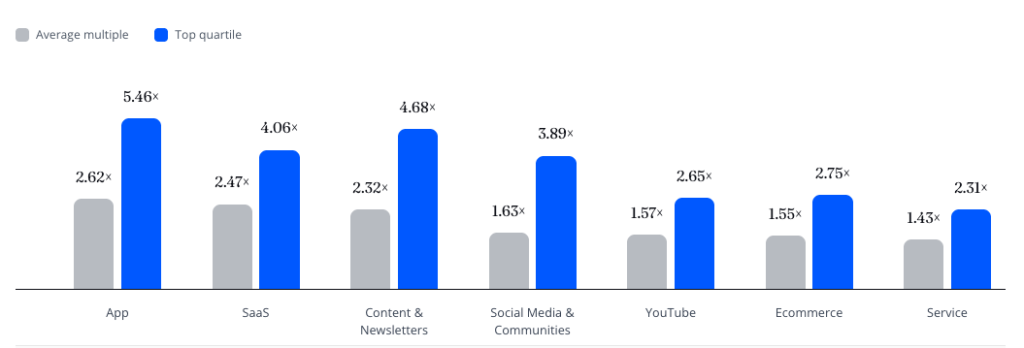
Ecommerce businesses sell on Flippa for an average of 1.55x profit, while businesses in the top quartile achieve 2.75x, according to our H1 2026 Insights Report.
Source: Flippa, H1 2026 Insights Report
Strong financial performance, consistent growth, diversified revenue, and efficient operations can all contribute to achieving a multiple towards the higher end of the market.
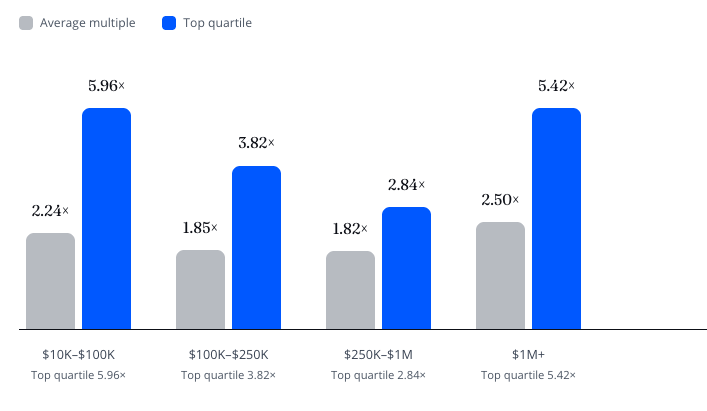
Our H1 2026 Insights Report also found deal size impacts multiples, with businesses across all categories under $100K and above $1M commanding higher multiples.
Source: Flippa, H1 2026 Insights Report
The report found high-growth, early-stage assets and larger, institutionalised digital businesses were driving elevated profit multiples. Read our Amazon FBA valuation multiples guide to dive deeper into how multiples impact the value of your business.
Top-quartile Amazon FBA businesses tend to share a few similar characteristics that make them more attractive to buyers:
All of these factors can positively impact your Amazon FBA business valuation when it comes to listing.
Amazon businesses are typically valued on seller’s discretionary earnings (SDE) for smaller assets and EBITDA for larger ones.
SDE is your net profit with owner compensation and one-time or discretionary expenses added back in.
The formula for an Amazon FBA business is:
SDE = Revenue – COGS – Amazon fees – operating expenses + eligible add-backs
Common Amazon FBA business add-backs include:
Normal operating costs, which are not considered add-backs, can include:
For example, a business with $150,000 net profit, $75,000 owner compensation, and $10,000 in add-backs from personal travel to a conference would have $235,000 in SDE.
Add-backs aren’t automatically accepted by the buyer, who will often want to see supporting documentation to justify adding them back into the SDE calculation.
For most FBA exits, buyers look at a clean 12–24 month window, normalized for add-backs and seasonality.
These are strong fundamentals, but technology is changing how FBA businesses are built, operated, and valued. AI is opening up new ways for sellers to streamline operations and buyers are now looking at how AI is being used as part of their diligence.
AI has featured in almost every mergers and acquisitions (M&A) conversation on Flippa in H1 2026. On Flippa, searches for ‘AI-powered business’ grew 20% and AI-related Ecommerce listings grew 26% in H1 2026, the sharpest incline across every category.
The demand for AI-integrated businesses is there and Ecommerce stores are hearing the call the loudest, incorporating AI across operations, customer support, and marketing automation.
For FBA businesses, AI applications could include:
In-platform, Amazon recently introduced a new agentic conversational tool called Seller Assistant, which allows sellers to ask questions about business performance, monitor account health, and optimize inventory.
Whether you use third-party AI tools or AI features built into Amazon, buyers will want to understand how these tools are used in the business, what they cost, how they optimize operations, and who manages them. Documenting this will help buyers easily assess whether the benefits are transferable.
AI is also changing the other side of the marketplace in terms of how customers discover and evaluate products on Amazon. As Amazon continues to build AI into the shopping experience, buyers may also look to see how changes in AI-driven product discovery could impact business visibility and sales.
For sellers, this means being honest about AI exposure, detailing where AI is, or has the potential to, impact sales and potential paths towards mitigating any disruptions to revenue.

Source: Flippa, H1 2026 Insights Report
Your unit economics sit on top of a predictable fee stack. Fees vary by category and weight/dimensions, so always verify the latest rates in Amazon’s Seller Central dashboard. What matters most to buyers is your contribution margin at the SKU level.
Present landed cost per SKU (factory to customer), contribution margin after all Amazon fees, return/defect rates, and inventory turns. That’s the view buyers use to evaluate resilience.
Make your business easy to understand and low risk to take over. These three levers below widen your buyer pool and speed up offers.
Gather and store all of your business data, standard operating procedures (SOPs), and financial information in a virtual data room (VDR) so buyers can easily access the information they need during due diligence.
A VDR offers a secure and central space where authorized users can access information while ensuring compliance and data protection standards. If you sell your Amazon FBA business on Flippa, a virtual data room is included as part of BrokerAI, our AI layer for business brokerage.
Here’s what to assemble in your VDR:
Write SOPs for inventory planning, supplier ordering, listing updates, review management, customer service, and PPC. Include a 30–60–90-day training plan outlining weekly calls, email support, and milestones so buyers see a smooth handover.
Map who does what today. If VAs or contractors handle support, content, or ads, confirm their willingness to continue post-sale and note hourly rates and scopes. Buyers prefer businesses that don’t feel like a full-time job on day one.
Finally, be sure your business is profitable for the previous 12 to 24 months. A long-term healthy account indicates to buyers the business can likely withstand seasonality and market shifts.
Finding buyers is just one side of the coin, while negotiating a great deal is the other. Many sellers often have no trouble finding buyers for their Amazon FBA business, but the problem is negotiating a deal that benefits both them and the other party. Here are some tips to help:
Buyers will make an offer based on the perceived value of your business. If you’re looking to make your business more valuable, here are a few areas to focus on.
Buyers look for consistency. Avoid stockouts, monitor return reasons, and maintain review velocity to keep key SKUs in stable BSR ranges. Show 12–24 months of BSR and inventory history to prove resilience.
A simple, fast site with email capture, basic content, and pixel tracking helps reduce dependence on marketplace traffic. Even modest DTC revenue, a warm email list, or a retargeting audience can strengthen your position.
Document primary and backup suppliers, lead times, MOQs, and quality control steps. Keep contracts, compliance certificates, and test reports organized. Negotiated terms and dual sourcing reduce risk and support better multiples.
Present PPC the way a buyer will inherit it. Share bulk files, search term reports, and negative keyword lists. Show TACoS and ACOS trends, creative tests, and steps you have taken to protect margin during peak periods.
Source: Flippa, H1 2026 Insights Report
If you’re ready to list, we’ve put together a FBA business sale checklist to help you get started.
Water filtration brand Weeplow built a brand that set out to replace bottled water with a sustainable, cost-effective alternative.
They secured trademarks across markets and invested in credible lab testing, building an IP and compliance moat few competitors could match.
Their O’Pure 2 filters quickly became bestsellers on Amazon France. At listing, the company generated €3.5M in annual revenue, €1.45M in annual profit with a 41% profit margin. In 2025, the company was acquired for $3.7M.
The numbers:
These figures underline what made Weeplow so attractive: high-margin profitability, a lean SKU portfolio, and a return rate of just 1.7%, well below industry averages.
Read the full case study here.
Some ways to find buyers include:
Ready to sell your Amazon FBA business? You’ll need to price it against current market multiples, prepare and document operations, assets, and processes, and choose a transfer path that aligns with Amazon’s policies.
If you’re ready to explore next steps, get a free FBA business valuation to set expectations, then open conversations with qualified buyers. When your books are tidy and your transition plan is clear, you’ll be in a strong position to negotiate the outcome you want.
Whether you’re just exploring a sale or preparing to list your business, these guides will dive deeper into the process, from valuation through to closing.
No, seller accounts aren’t generally transferable. However, you can sell your FBA business either as a stock/equity sale where the legal entity stays the same and you notify Amazon to update account details, or as an asset sale, where you migrate listings and Brand Registry roles to the buyer’s own seller account.
Ecommerce businesses averaged a 1.55x profit multiple in H1 2026, with top-quartile businesses reaching 2.75x on our marketplace.
Your FBA business’s profit multiple will depend on a number of factors, including profit, growth, brand strength, and owner involvement.
Yes, Brand Registry matters for FBA valuation because it can strengthen your business’s defensibility by giving you access to additional protection and brand-building tools. Buyers may consider Brand Registry enrollment alongside other indicators of brand strength, such as a registered trademark and customer reviews.
For many Amazon FBA owners, Flippa is a strong platform to consider when choosing to sell their business. Flippa has a dedicated Amazon FBA marketplace, valuation tools that use historical transaction data, and a global pool of quality online buyers. You can either list your business yourself or work with a broker.
It varies widely by category, price point, and execution. Many sellers treat FBA as a side income, while others operate full-scale brands. What matters most is your contribution margin after fees and returns, inventory turns, and your ability to keep best-sellers in stock.
Starting with no capital is difficult, but you can begin lean by reselling limited quantities, testing small private-label runs, or partnering with an investor. Plan for product, packaging, freight, FBA fees, and ad spend before you scale.
Yes. Many owners build brands that replace full-time income. The keys are product-market fit, reliable supply, healthy margins after fees, and disciplined PPC. Consistency matters more than quick spikes.
There is no single valuation multiple for Amazon FBA business, as the final price depends on profitability, growth, risk, and operational complexity. Current Ecommerce market data shows an average profit multiple of 1.55x, while businesses in the top quartile achieve 2.75x.
Anywhere from a small side income to high six figures and beyond. Results depend on product selection, margin structure, review quality, inventory planning, ad efficiency, and how effectively you expand SKUs.
It’s possible, but rare without sustained scale. Owners who reach seven figures typically build a defensible brand, expand SKUs methodically, maintain strong margins, and either compound for years or exit at a solid multiple.
Smaller businesses are usually valued on SDE; larger ones may use EBITDA. Buyers normalize your financials (add-backs, seasonality) and weigh risk factors like SKU concentration, defensibility, growth, and account health. Use Flippa’s free valuation tool to get an accurate idea of your business’s worth.
For many sellers, yes. FBA provides Prime-eligible shipping, returns handling, and scalable logistics. The trade-off is fees and less control over some operations. Run your unit economics per SKU; if margins remain healthy after fees and returns, FBA can accelerate growth.

Hear from business owners and entrepreneurs who have bought and sold online businesses on Flippa.

Search our knowledge base for answers to common questions.