Shopify valuation multiples in 2026: real data from sold deals


Blog


 The Exit Podcast
Profit gets your Shopify store on a buyer’s radar, but what indicates real value is the multiple. In H1 2026, the average Ecommerce business sold for 1.55x profit on Flippa. Top-quartile businesses commanded 2.75x.
So what separates an average store from a premium one? It all comes down to proof and preparation. Market conditions establish the range buyers are willing to pay, but a business’s quality, performance, and risk profile determines where it lands within that range.
In this guide, we’ll break down the key metrics and factors that influence a Shopify valuation multiples, and what you can do to strengthen your valuation before listing.
A multiple is one of the simplest ways buyers can compare the value of a Shopify store with its financial performance. It’s an indicator of how much a buyer is willing to pay relative to business profit.
For most profitable Shopify stores, the calculation is:
Estimated business valuation = Financial metric x Multiple
For example, if your Shopify store generates $375,000 in annual profit and comparable stores are selling for a 2.75x multiple, the final valuation would be $1.03M.
However, that Ecommerce valuation multiple isn’t fixed. The quality of your business is what influences where it sits within the market range.
To calculate the financial metric that’s part of this equation, most Shopify store owners use the seller’s discretionary earnings (SDE) method. Alternate methods include earnings before interest, taxes, depreciation, and amortization (EBITDA), and revenue.
Here are three common Shopify multiple methods and when they’re most often used.
Ecommerce valuation methods
| Valuation method | When to use |
| SDE multiple | Owner-operated businesses or businesses with <$500K revenue |
| EBITDA multiple | Mid-size to institutional businesses that run under management |
| Revenue multiple | High-growth business or businesses where earnings are low or inconsistent |
The next stage of the equation is estimating the multiple for your store.
Understanding Ecommerce multiple benchmarks can help you assess how your Shopify business’ performance compares with other similar sold businesses.
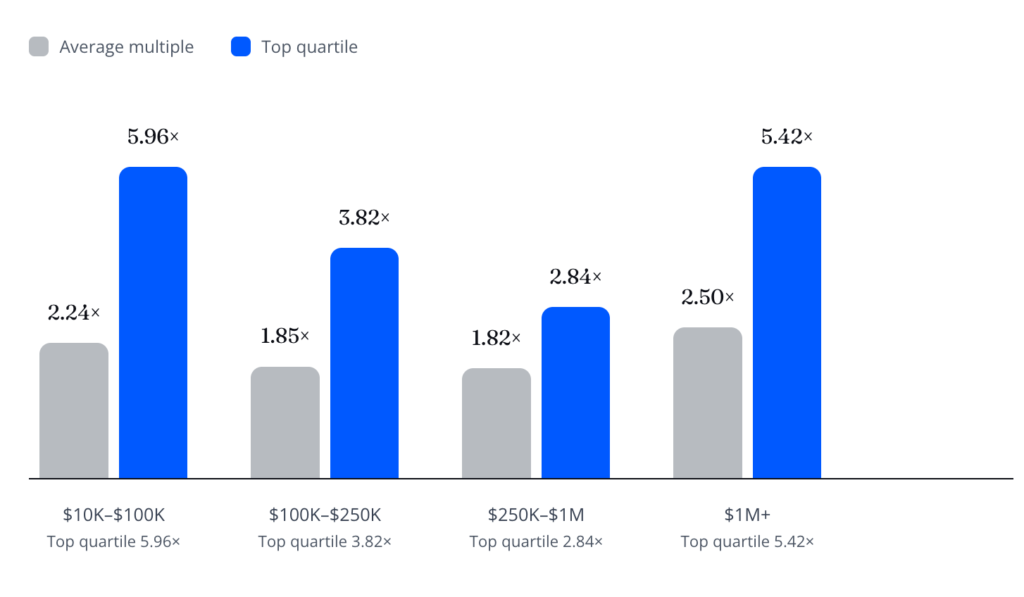
Our H1 2026 data groups Shopify stores under the Ecommerce category, which showed the top-quartile multiple at 2.75x and the average multiple at 1.55x, based on sold deals on Flippa.
In terms of price band, our data shows multiples follow a U-shaped curve when categories are grouped by sold deals, with the strongest multiples at the smallest and largest ends of the market.
The higher multiples at the sub-$100K band likely reflect a wider mix of high-growth, early-stage assets, while the premium $1M+ band likely represents the scarcity value of larger, institutionalized businesses.
Source: H1 2026 Insights Report
Historically, both profit and revenue multiples for Ecommerce assets have declined since their earlier peaks; however, between the two, profit multiples remain slightly higher.
This suggests profitability, not revenue, is playing an increasingly important role in how Shopify stores are valued.
How Ecommerce multiples have changed over the years
| Multiple | Peak | H1 2026 | Percentage change |
| Average profit multiple | 2.48x | 1.54x | -37.9% |
| Average revenue multiple | 1.12x | 0.51x | -54.5% |
Want to know where your store sits? Flippa’s free Shopify valuation estimates your store’s value using marketplace data from Ecommerce assets sold in H1 2026.
To improve your store’s multiple, you need to know what buyers are valuing in 2026.
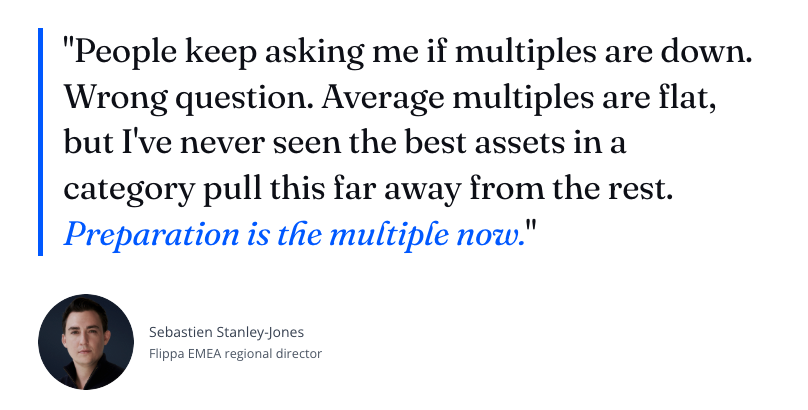
Let’s focus on top-quartile Shopify stores. These businesses likely garner a higher multiple because they’re able to successfully prove to buyers what makes their store sustainable, profitable, and transferable.
That means demonstrating a number of factors, including owner independence, honest AI exposure, and a strong and irreplicable brand, just to name a few.
Let’s dive into these drivers that can help shift your Shopify store towards the top end of the Ecommerce multiples range.
Source: H1 2026 Insights Report
Buyers want to know a store can generate sales without being dependent on a single acquisition channel.
A Shopify business with a mix of organic, email, direct, social, and paid traffic gives potential buyers more confidence that revenue isn’t reliant on one platform. The more concentrated a traffic source, the more exposed a business is to third-party changes.
Take paid channels. Advertising can be a great way to scale a new Shopify store, but algorithm changes and rising customer acquisition costs (CAC) can impact both traffic and profit very quickly.
It’s a similar story with organic search. The introduction of AI Overviews on Google search pages has changed how users interact with search results, with software company Ahrefs finding AI Overviews reduced clicks to top-ranking content by 58%.
Buyers are likely to favor stores where customers arrive through a combination of channels.
Most Shopify stores rely on apps to add functionality, automate processes, or improve customer experience. The issue for buyers here isn’t about how many apps you use, but whether those apps have a reason for being there and what they cost to keep the store running.
A long list of apps can make a store look more complex than it needs to be. Unused subscriptions, overlapping features, and test apps that weren’t removed all add unnecessary costs to a business. They also diminish page performance if they require excessive code.
Because software will form part of the buyer’s ongoing operating costs, it’s worth cleaning up and documenting your app stack to make the business easier to diligence.
For Ecommerce businesses, revenue is often only part of what a buyer acquires. A Shopify store with an established brand presence gives sellers an asset that’s much harder for competitors to replicate.
It’s one of the reasons why buyers might value an owned, private-label brand over a white-label store selling readily available items that other sellers could stock.
An established brand, supported by a registered trademark and recognizable logo, can offer buyers greater protection from duplication.
Here are a few signals your brand has a strong presence:
These signals give buyers a better understanding of whether they’re acquiring a durable business or one that can be replicated.
Buyers want to know whether the sales and profits from a business are normal trading performance. Shopify Payments can give them this.
Shopify Payments records transaction history, including refunds and payouts. A consistent history over 12 months or more without significant holds or recurring issues can make the financial records due diligence more straightforward for buyers.
A clean payment record isn’t automatically going to drive up the premium of your store, but it can remove uncertainty from the financial documentation.
A buyer doesn’t just look at the store itself, but also at the systems and processes that keep it in operation.
That includes how embedded the owner is in the business. If the owner is still running ads and negotiating with suppliers themselves, and there’s no clear process for transferring those responsibilities, it can be a potential red flag for potential buyers.
This is where documentation and comprehensive standard operating procedures (SOPs) come into their own. When you map out the tasks you currently handle and document how each one gets done, who’s responsible for it, and which tools are involved, you make the transfer process much clearer for the buyer.
Where possible, delegate these responsibilities and negotiate supplier contracts before listing.
AI is a new diligence consideration in 2026 for Ecommerce buyers, both in terms of integration and exposure.
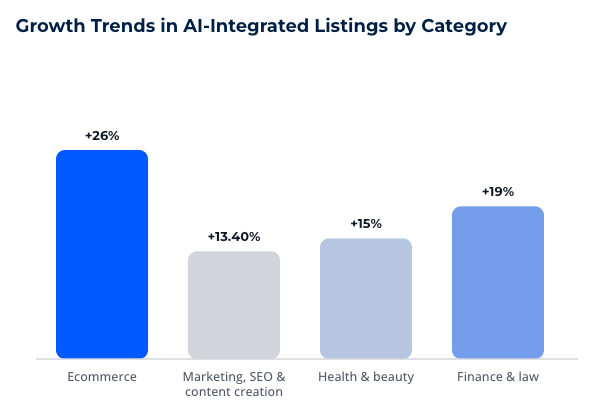
On our site, searches for ‘AI-powered businesses’ grew 20% in H1 2026 compared to the same period the year previously, while on the supply side, AI-integrated listings in Ecommerce grew 26%.
Source: H1 2026 Insights Report
Our H1 2026 Insights Report identifies AI as both an efficiency opportunity but also a potential channel risk to buyers.
For sellers, that makes documentation of AI tools especially important. If you’re using AI to handle customer service, analyze data, or automate tasks, document what these tools do and what benefit they provide. Quantify the gains from using the tool, such as ‘x’ hours saved per week.
This gives buyers a more tangible way to assess AI integrations. On the other side, buyers also need a tangible way to understand how you’re addressing traffic disruption from AI models.
That means being prepared to explain both sides of AI impact on your business: where it’s making your store more efficient, and where AI-driven search or discovery could impact acquisition channels (and steps in place to address those potential changes).
The same factors that can strengthen your valuation are the same that can work against it if they’re missing.
Buyers are pricing the profit today and the potential risks they might inherit in the future. This includes:
These factors apply across the Ecommerce category, including both Shopify and Amazon FBA businesses. However, the way those risks show up can differ between the two platforms.
Multiples aren’t static. The preparation you do now can have an outsized impact on your final valuation. Here are three actions we’d recommend taking at least 90 days out from listing.
Before you list your store, review every app currently installed on your Shopify store and consider:
Remove apps that are redundant, unused, or no longer providing enough value to justify their cost.
Strengthen and broaden your acquisition channels prior to listing. That means building strategies to target potential customers through email, social, paid, and search.
Reduce your dependency on one specific channel, whether that’s paid or organic search. While they can be effective at the start, a mature business knows that relying on either channel long-term can be risky.
Buyers want to know the store can run profitably, regardless of who’s at the helm. To prove this, establish a robust set of standard operating procedures (SOPs) and build documentation around every part of the business you currently have touchpoints with.
This process also helps you spot any areas where you might have more of an influence than you realised.
Ready to take action? Our quick and easy Shopify store sale checklist will help you get your store ‘sale-ready’ before listing.
Both Shopify and Amazon FBA stores are Ecommerce businesses, so they can be assessed using similar valuation principles and multiples. However, both platforms create different risk profiles for potential buyers.
The biggest difference is control. A Shopify store gives the owner greater control over the storefront, while an Amazon FBA business works within Amazon’s marketplace, which provides access to an existing and active audience.
Let’s break it down into categories for each platform:
A comparison of Shopify and Amazon FBA stores by feature
| Feature | Shopify | Amazon FBA |
| Customer data | Greater control over customer data and relationships | More limited because transactions take place within Amazon’s marketplace |
| Traffic diversification | Owner needs to build traffic across paid, organic, email, and direct | Owner benefits from built-in marketplace traffic |
| Platform dependence | Low platform dependence; Shopify provides infrastructure for owners to build an independent store. | High platform dependence; owners list products within Amazon marketplace |
| Brand ownership | Greater control over brand strategy and presentation | Brands can be built on Amazon, but customer experience remains within Amazon marketplace |
| Fulfillment | Independent from Shopify | Handled by Amazon |
Different platforms attract different types of buyers for different reasons. Financially-motivated buyers, such as private equity firms or individual investors, will generally value a Shopify store based on sustainable cash flow.
More strategic buyers will often justify paying a premium when the acquisition benefits their existing businesses. For Shopify businesses, a strong consumer brand and diversified traffic mix can attract strategic interest beyond the store’s standalone earnings.
For more information on Amazon FBA multiples, take a look at our Amazon FBA valuation multiples guide.
Australian automotive Ecommerce brand The Cruiser Store exited for $2.2M AUD on Flippa, just 30 months after it was founded.
Its young age could have limited its valuation, but the company’s healthy customer retention, high return on ad spend (ROAS), and founder independence helped it sell at a 2.6x profit multiple.
The numbers:
Time to Exit: 2.5 Years
Annual Revenue: $3.5M AUD
Profit Margin: 24%
Sale Price: $2.2M AUD
EBITDA multiple: 2.6x
Ecommerce multiples give you a useful benchmark for understanding how buyers view potential and scalability within the market.
If you want to know where your Shopify store sits among similar stores, we offer a free Shopify valuation. You can estimate your store’s value using marketplace data, including Ecommerce assets sold as recently as H1 2026.
Know where your business stands before you list, and identify what you can do to strengthen its value before you decide to sell your Shopify store.
Ecommerce businesses averaged a 1.55x profit multiple in H1 2026, with top-quartile businesses reaching 2.75x on our marketplace.
Your store’s profit multiple will depend on a number of factors, including profit, growth, brand strength, and owner involvement.
Generally, Shopify and Amazon FBA businesses can trade at different multiples. Buyers will look at the underlying value and potential risks of the specific business rather than apply a specific Shopify or Amazon multiple.
Yes, traffic sources can affect valuation. A diverse mix of proven acquisition channels indicates to buyers your store doesn’t rely on a single platform or small number of campaigns to generate sales.
There isn’t one universal benchmark for a top-quartile Shopify store. It depends on the business’ size, model, and growth potential. A store that can prove profitability, customer data, traffic, independence, and financial quality is more likely to attract higher multiples.

Hear from business owners and entrepreneurs who have bought and sold online businesses on Flippa.

Search our knowledge base for answers to common questions.