Shopify Store Valuation: What Your Business Is Worth in 2026


Blog


 The Exit Podcast
For Shopify store owners, business worth isn’t just about how much their store makes. It’s about what a potential buyer would actually pay to acquire it.
That’s where an Ecommerce business valuation comes in. Determining the value of your store is one of the most important steps in exiting successfully, helping you to make smarter, strategic improvements before listing.
Revenue plays a part in determining your Shopify store valuation, but only partly. Profitability, growth, traffic quality, brand strength, and store independence also heavily influence your store’s real market value.
In this guide, we’ll look at Shopify store valuations in 2026, the profit multiples buyers are using, and the steps you can take to understand and potentially increase value before you sell your Shopify store.
Business valuation is the process of determining fair market value through financial, operational, and market-based analysis.
For most Ecommerce businesses, the seller’s discretionary earnings (SDE) method is the preferred approach, especially for owner-operators with revenue under $5M.
Here is the formula:
Estimated business value = SDE x industry multiple
For a Shopify store, SDE generally starts with net profit and adds back eligible owner compensation, discretionary expenses, and personal expenses run through the business, such as travel or tech.
Your calculation should account for operating costs before applying appropriate add-backs.
Shopify-specific costs might include:
Owners should use SDE rather than straight revenue when valuing their store because revenue doesn’t account for the costs above that are required to generate that revenue.
For example, two Shopify stores could each generate $1M in revenue, but they might have very different levels of profitability. A store with significant app or advertising expenses may generate considerably less SDE than a store with the same revenue but fewer overheads.
A revenue metric, however, would treat both stores similarly, because it would only consider the sales. SDE reflects the earnings the business generates after accounting for costs.
Buyers typically look at a store’s 12-month trailing SDE, also referred to as TTM SDE, to better understand its recent financial performance.
It captures seasonal fluctuations and gives buyers a consistent basis for applying an SDE multiple. However, the TTM figure shouldn’t be viewed in isolation. If monthly earnings are steadily declining, for example, a buyer might scrutinize whether the 12-month figure accurately represents the current earning potential of the business.
For sellers, this means keeping financial records up to date and being prepared to explain monthly fluctuations or changes. This will help buyers determine whether the earnings are sustainable long-term.
Our H1 2026 Insights Report found top-quartile Ecommerce businesses achieved a profit multiple of 2.75x, compared with an average of 1.55x on our marketplace.
Here’s what that looks like in practice. Let’s say you’ve calculated a $400,000 SDE. Let’s apply that metric across the average and top quartile multiples for Ecommerce businesses.
Estimated valuation for an Ecommerce business using average and top-quartile multiples
| Multiple | SDE | Estimated valuation |
| 1.55x | $400,000 | $620,000 |
| 2.75x | $400,000 | $1,100,000 |
And profit multiples trended higher for categories in the smallest ($100K and under) and largest ends of the market ($1M+) based on sold deals on our site for H1 2026.
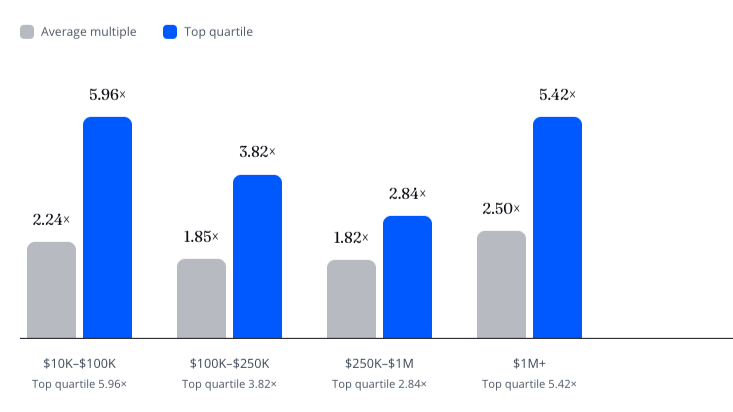
Source: H1 2026 Insights Report
The elevated multiples at the below $100K level likely reflect a wider mix of high-growth, early-stage assets. Multiples at the premium end of the market likely reflect the value in the scarcity of larger, institutionalized digital businesses.
So, what do top-quartile Shopify stores have in common? We’re seeing the focus shift to the quality of your store earnings, not just the size of your business. Diversified traffic, low-cost app stacks, and brand strength all contribute to positioning your store for stronger valuation.
Know the data-backed estimate of your business’s market value before you decide to sell.
Get a free Shopify business valuation
Benchmarks give you a useful starting point, but individual sold deals show why no two businesses are valued the same.
For example, a Shopify apparel brand that launched in 2019 with a single idea of improving the quality of wardrobe essentials sold just six years later on our site for $1.3M.
When the brand was listed on our site, they had $58K monthly profit, a 41% profit margin, a 1.9x profit multiple (asking price), and a 0.8x revenue multiple.
But those numbers only tell part of the story. The real levers that set this store apart were its customer loyalty metrics.
The company boasted:
This was proof that growth was driven by trust and retention over short-term discounts or sales. For buyers, this indicated sustainable, profitable growth that was built on quality and consistency, which led to the brand being acquired for $1.33M in 2025.
Knowing where you sit within industry benchmarks can be helpful, but that number’s not fixed. Here are a few ways you can add real value back into your store to improve your Shopify valuation multiples.
Relying on one or two traffic sources creates a dependency buyers don’t want. This is especially true if one of those sources is organic search, which was severely impacted by the addition of AI Overviews to the top of search results.
The same is true of customers. If you rely on one or two customers to fulfill the volume of your orders, your valuation will likely be reduced.
Work on strengthening your other channels to bring in new customers, from email and direct to organic social. Also, reduce your dependency on paid channels. They can be effective in generating sales, but changes in advertising costs, algorithms, and account performance can negatively impact your profitability.
Millions of Shopify store owners use apps to improve functionality and drive growth on their site; however, there is such a thing as too many apps.
Over time, adding more apps to your tech stack can put unnecessary strain on your storefront, such as code that can slow down your page load speed and ruin the customer experience.
For buyers, a long list of unused apps looks untidy at best, costly at worst. Clean up your app list by removing any unused or duplicate-feature apps to prevent buyers from purchasing a business with unnecessary software costs and a complicated tech stack.
A strong brand can give potential buyers more confidence in the long-term value of your Shopify store. When customers recognize your brand, return to purchase, and actively seek out your products, the business becomes less dependent on paid traffic and shorter-term acquisition tactics.
This makes owned brands, compared to white-label dropshipping stores that source generic products from a pool other sellers can draw from, a more lucrative option for buyers.
Here are a few signals that your brand has a strong presence:
Brand strength demonstrates that your store has customer loyalty and continual demand, which makes future earnings more resilient for new owners.
An established Shopify Payments history gives buyers an accurate sales and transaction history of your store, including transaction volume, refunds, payout history, and account history or status.
For a buyer, this helps verify any financial records made by the store owner and gives greater insight into the historical performance of the store. A clear and consistent payment history can also make due diligence much more straightforward, giving buyers greater confidence in reported figures.
Payment history also gives insight into the quality and consistency of your store’s trading history, showing an established operation as opposed to the store simply going through a shorter period of unusually strong sales.
Buyers looking to invest in your Shopify store will want to know it can stand on its own when you leave. To prove this, you should establish a robust set of standard operating procedures (SOPs) and build documentation around every part of the business you currently have touchpoints with.
This process helps you spot any areas where you might have more of an influence than you realised, for example, with supplier relationships. Take the time to delegate tasks and negotiate supplier agreements now to signal the store is independent of any single person.
Shopify stores constantly relying on new customers to drive revenue growth are often playing a losing game. More new customers often means investing more in acquisition channels, which can be volatile and costly over time.
Building a strong customer base can help alleviate those acquisition costs, with real store value coming from return customers.
Using Shopify Plus can signal to potential buyers your store has reached a level of scale or operational complexity that warrants a more advanced setup.
Advanced features like automation and additional infrastructure can indicate the owner is invested in building a business that can handle higher volumes. However, purely having Shopify Plus isn’t a gateway into a higher valuation multiple.
Buyers are assessing the underlying performance of your store, such as its profitability, sustainability, and independence, not just the plan it runs on.
If you have Shopify Plus, demonstrate to buyers the features your store uses to help buyers understand the benefits of the subscription.
Both Shopify and Amazon FBA stores are Ecommerce businesses, so they can be assessed using similar valuation principles and multiples. However, both platforms create different risk profiles for potential buyers.
The biggest difference is control. A Shopify store gives the owner greater control over the storefront, while an Amazon FBA business works within Amazon’s marketplace, providing access to an existing and active audience.
Let’s break it down into categories for each platform:
A comparison of Shopify and Amazon FBA stores by feature
| Feature | Shopify | Amazon FBA |
| Customer data | Greater control over customer data and relationships | More limited because transactions take place within Amazon’s marketplace |
| Traffic diversification | Owner needs to build traffic across paid, organic, email, and direct | Owner benefits from built-in marketplace traffic |
| Platform dependence | Low platform dependence; Shopify provides infrastructure for owners to build an independent store | High platform dependence; owners list products within Amazon marketplace |
| Brand ownership | Greater control over brand strategy and presentation | Brands can be built on Amazon, but customer experience remains within Amazon marketplace |
| Fulfillment | Independent from Shopify | Handled by Amazon |
These factors can all influence how buyers assess risk and sustainability of your store’s earnings, which in turn can impact your Shopify or Amazon FBA business valuation.
With that in mind, let’s walk through practical steps you can take before your listing to strengthen your store and gain a higher valuation.
Before you list your store, you need to get it ‘sale-ready’. We’d recommend taking these steps at least 90 days before listing to give you enough time.
Before you list your store, review every app currently installed on your Shopify store and consider:
Remove apps that are redundant, unused, or no longer providing enough value to justify their cost.
Paid channels are a great way to build growth in the short term, but relying on paid channels can increase your customer acquisition costs (CAC) in the long term.
Here are a few ways you can shift your first-time buyers into a more organic, retention-focused audience:
Turning first-time buyers into loyal shoppers takes time. Having a recognizable brand presence can help.
A strong brand is about more than a logo and Shopify storefront. When you’re preparing your business for sale, document the brand assets you’ve built and the evidence that shows customers recognize, trust, and follow your brand.
Create a brand asset list that includes:
Keeping these assets organized and accessible makes it easier for buyers to understand what they’re acquiring outside the Shopify store.
The better prepared your store is for due diligence and a smooth transition, the stronger the case is for improving your valuation multiple.
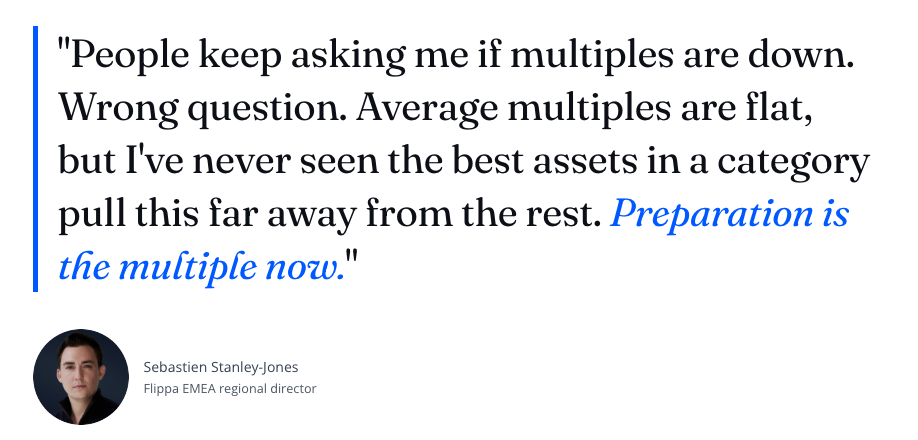
Source: Flippa, H1 2026 Insights Report
If you’re ready to list your store, we’ve put together a Shopify Store sale checklist you can use to make sure you’re prepared well before your first buyer questions.
Valuing a Shopify store comes down to more than just revenue or standard multiples. Buyers are diving deeper into businesses, looking at a range of factors including the quality and sustainability of earnings, traffic diversity, and platform or owner dependencies.
The good news is, many of these factors are already within your control to optimize. And that’s where good preparation will set your store apart from the rest.
The more confidently and clearly you can demonstrate the value your store offers to prospective buyers, the stronger a position you’ll be in come negotiations.
Ready to find out what your Shopify store could be worth? Get your free Shopify store valuation with Flippa and see how your business measures up before you list.
The worth of your Shopify store depends on a range of factors, from its SDE through to its traffic sources, brand strength, and operational independence. A common starting point for estimating your store’s worth is to multiply your SDE by an appropriate multiple.
A Shopify store is generally valued using the same principles as other owner-operated Ecommerce businesses, using SDE metrics alongside multiples.
The Shopify platform can, however, affect how buyers assess risk and perceived value. Factors like customer data, traffic diversification, app dependencies, and brand ownership can all influence value.
Not necessarily. Shopify apps are considered operating expenses, so they are often reflected in your SDE. What matters is whether the app is necessary and functional enough to justify that cost.
In general, buyers will look at overall profitability and efficiency of a store over the number of apps it uses.
Ecommerce businesses averaged a 1.55x profit multiple in H1 2026, with top-quartile businesses reaching 2.75x on our marketplace.
Your store’s profit multiple will depend on a number of factors, including profit, growth, brand strength, and owner involvement.

Hear from business owners and entrepreneurs who have bought and sold online businesses on Flippa.

Search our knowledge base for answers to common questions.