Fixed vs. Growth Mindset: Why Your Beliefs Rule Your Life (And How to Change Them)


Blog


 The Exit Podcast
There’s a moment a lot of business owners hit.
The business is working. Revenue’s coming in. The offer makes sense. The systems aren’t falling apart.
But something inside starts to go flat.
The founder keeps doing what worked before, except the next level doesn’t respond the same way anymore. They avoid harder conversations. They delay the new hire. They push back on feedback. They keep trying to solve today’s problem with who they were two years ago.
And most people at that point think they need more talent, more discipline, or more time.
Sometimes they do.
But usually, the real problem is deeper than that.
It’s the internal operating system.
Some people plateau because they quietly start protecting what they’ve already built. Others keep climbing because they keep asking who they need to become next.
That’s the heart of a growth mindset.
A growth mindset is the belief that ability can be developed through practice, effort, strategy, and honest feedback. It doesn’t mean anyone can become anything overnight. It doesn’t mean talent is irrelevant. It just means your current ability isn’t the final version of you.
Mindset isn’t a birthright.
It’s a muscle.
And like any muscle, it grows through use.

A fixed mindset sees ability as something you’re either born with or you’re not.
It says things like:
“I’m just not good at this.”
“I’m not a numbers person.”
“I’m not a natural leader.”
“I tried once. It didn’t work.”
A growth mindset sees ability as a starting point, not a ceiling.
It asks:
“I haven’t learned this yet, so what’s the next step?”
“What is this situation showing me?”
“Where do I need a better strategy?”
“Who can give me actual honest feedback here?”
| Situation / Metric | The Fixed Mindset Response | The Growth Mindset Response |
| Facing a Market Shift (e.g., A competitor launches a better product) | Defensive & Anxious: “They have more capital than us. There’s no way we can compete with that team.” | Curious & Analytical: “What gaps did they find that we missed? Let’s study their product and iterate ours.” |
| Handling Critical Feedback (e.g., A negative customer review) | Personal Collapse / Defensive: “This customer is wrong and unreasonable. We suck at this.” (Or deletes the review). | Data Collection / Looks for Signal: “Is there a 5% truth here? Does our product or onboarding process have a blind spot?” |
| Approaching New Skills (e.g., Learning financial modeling) | Identity Avoidance: “I’m a creative person, not a numbers person. I’ll just hire someone to worry about that.” | Patient Beginner: “I don’t know how to read a P&L statement yet, but I can learn the basics over the next month.” |
| Dealing with Employee Mistakes (e.g., A team member misses a deadline) | Blame & Control: “If you want something done right, you have to do it yourself. I’m taking back control.” | Systems Thinking: “Where did our communication break down? How can we improve the training process to prevent this?” |
| Viewing Peer Success (e.g., A competitor raises a massive round) | Threatened & Bitter: “They just got lucky. The market is getting too crowded anyway.” | Inspired & Motivated: “Their success proves the market demand is huge. If they can do it, what can we learn from their playbook?” |
| Challenges (e.g., Upgrading to enterprise sales) | Avoids to Protect Identity: “We are a SMB-focused company; enterprise clients are too much corporate bureaucracy anyway.” | Treats as Training: “This forces us to uplevel our security, onboarding, and pitch. Let’s see what it takes to close just one.” |
| Obstacles (e.g., A major supply chain disruption) | Withdraws & Postpones: “The timing is cursed. Let’s pause the launch entirely until things return to normal.” | Pauses, Adjusts, Keeps Going: “The macro environment changed. How do we reformulate the product or pivot the offer to launch anyway?” |
| Effort (e.g., Grinding through cold outbound) | Proof of Weakness: “If our product was actually good, people would be flocking to us organically. This is a waste of time.” | The Path to Mastery: “Outbound is a game of conversion loops. Every ‘no’ gives us data to refine the script and targeting.” |
| Failure (e.g., A high-budget marketing campaign flops) | Identity Statement: “I am bad at marketing. I don’t have the instinct for this and we just flushed cash down the toilet.” | Treats as Feedback: “The campaign failed, but the data shows our hook was weak while the click-through was high. Let’s tweak the copy.” |
This difference matters in business because every founder eventually runs into something they can’t solve with the way they’re currently thinking.
A growth mindset doesn’t remove pressure. It changes your relationship with pressure.
The fixed mindset isn’t “bad,” by the way.
Most of the time, it’s protection.
It protects the ego from embarrassment. It protects the founder from feeling behind. It protects the high performer from being seen as uncertain.
But protection isn’t always leadership.
There are seasons when the part of you trying to protect you is also the part keeping you small.
Your brain is not fixed, it isn’t a finished object.
It’s more like living clay.
It changes through experience, repetition, attention, and practice. When you learn a new skill, respond differently to feedback, or repeat a new behavior long enough, your brain starts forming and strengthening new pathways.
This is called neuroplasticity. In plain terms: the brain can reorganize itself.
That matters because most people talk about themselves as if their current patterns are permanent.
“I always avoid conflict.”
“I always overthink.”
“I always procrastinate.”
“I always shut down when things get hard.”
But what feels permanent is usually just familiar.
The brain repeats what it’s practiced. The body repeats what once felt safe. The mind returns to old patterns because old patterns take less energy than conscious change.
This is why growth isn’t just about thinking differently.
It’s about practicing differently.
Again and again.
Until the new response is easier to reach than the old one.
You’re not stuck with the brain you have right now. But you do have to participate in shaping the one you want to use.
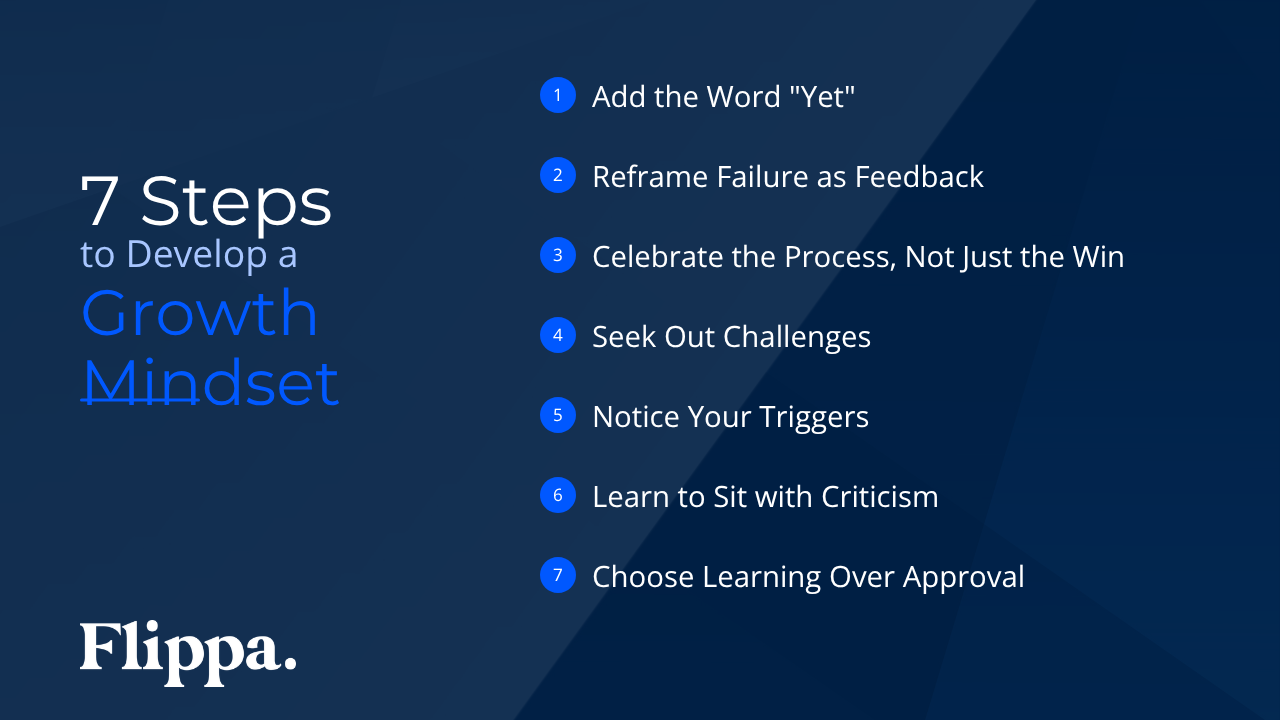
There’s a quiet but significant difference between these two sentences:
“I can’t do this.”
“I can’t do this yet.”
The first one closes the door. The second one leaves an opening.
A founder who says “I can’t build systems” might stay trapped in owner-dependence for years. A founder who says “I haven’t learned how to build systems yet” starts looking for the next clean step.
“Yet” doesn’t solve the problem. It keeps you in relationship with possibility.
Try it. Next time you hear yourself say “I’m not good at this,” add one word. Then ask: what would the next small lesson be?
Failure gets heavy when we turn it into identity.
The campaign failed, so I’m not good at marketing. The deal fell through, so I’m not cut out for sales. The team member left, so I’m a bad leader.
That’s the fixed mindset protecting itself. It turns one event into a permanent verdict.
A growth mindset looks at the same moment and asks different questions. What did this reveal? What assumption was wrong? What pattern keeps showing up here?
In business, feedback usually arrives wearing uncomfortable clothing. It looks like churn, slow sales, a difficult buyer conversation, a team issue that keeps coming back.
But underneath the discomfort, there’s data.
Not an attack. Data.
When you can take the lesson without collapsing into shame, you become very hard to stop.
Most people were trained to celebrate outcomes. The closed deal. The revenue milestone. The award.
Nothing wrong with that. But if results are the only thing you reward, you start avoiding anything that makes you look like a beginner.
That’s exactly where growth slows down.
Did you ask for feedback even though it felt uncomfortable? Did you stay in a hard conversation instead of exiting it? Did you fix the system instead of blaming the person? Did you show up again after the first attempt didn’t work?
That’s growth.
Effort without reflection can become noise. But effort with strategy, honesty, and adjustment becomes mastery.
Reward the process.
Comfort isn’t wrong. But staying comfortable too long makes the inner system soft in places where it needs strength.
A challenge shows you your current edge. It shows you where you tighten, what you avoid, which part of your identity is still built around staying safe.
For a founder, that challenge might be raising prices, hiring leadership, preparing the business to run without you, or finally sitting down with the actual numbers.
The challenge isn’t just external.
It’s internal.
Can you stay steady when you’re not the smartest person in the room? Can you receive feedback without immediately defending yourself? Can you make decisions from clarity instead of pressure?
That’s where growth happens. Not in the fantasy of being ready. In the practice of becoming ready.
Everyone has fixed mindset triggers.
A peer announces something big and something tightens in you. A buyer pushes back on your valuation and your body braces. A team member gives you feedback and your mind starts building a defense. A post flops and the inner commentary gets loud.
The trigger itself isn’t the problem.
The problem is reacting to the trigger without ever noticing it happened.
Growth starts when you can pause and ask: what just happened in me?
Not as judgment. As observation.
Maybe you want to prove something. Maybe you want to withdraw. Maybe you want to control the room. Maybe you want to look certain when you actually need support.
That moment of noticing is everything.
You can’t shift a pattern you’re still fused with. Once you notice it, you create space. And in that space, you can choose a cleaner response.
Most people say they want feedback.
Fewer people can actually stay open when the feedback touches something tender.
Honest criticism can feel like a threat when your identity is built around being the capable one, the right one, the respected one.
But feedback is often a free masterclass. Someone is showing you what you can’t see from inside your own pattern.
Slow down before reacting. Notice what tightens. Ask yourself: is there even 5% truth here?
You don’t have to accept every opinion. You don’t have to let every voice into your inner world. But if the feedback is coming from someone credible, someone who understands the game you’re playing, listen for the useful signal.
The goal isn’t to be liked. The goal is to keep learning.
Approval feels good. But if approval becomes the goal, growth becomes fragile.
You start choosing the safer move. Keeping the offer vague. Avoiding the hard decision. Performing confidence instead of building competence.
Learning asks a different question. Not “how do I look?” but “what can I take from this?”
That question brings you back to yourself. Out of performance, into presence.
This matters for founders especially because business constantly exposes identity. It’ll show you where you’re clear and where you’re compensating. Where you trust yourself and where you need others to validate you. Where you’re leading from calm and where you’re pushing from pressure.
The more you choose learning over approval, the more grounded your decisions get.
Michael Jordan didn’t make his high school varsity team as a sophomore. He was placed on JV, not cut from basketball entirely. But the lesson holds. He met disappointment, used it as fuel, and kept developing. That moment didn’t become his identity. It became part of his training.
Most strong founders have a version of this story. The first offer didn’t sell. The first hire didn’t work. The first investor said no. The first product was too complicated. The first version of the company needed to be rebuilt. The ones who grow aren’t the ones who avoid those moments. They’re the ones who face them without deciding they’re finished. They look at the data, adjust, and come back.
Think about learning an instrument. At first your fingers feel awkward. The timing’s off. The sound is rough. You know what it should sound like but your hands can’t produce it yet. If you take that personally, you stop. If you understand that awkward is part of learning, you continue.
Leadership feels awkward before it feels natural. Delegation feels uncomfortable before it feels clean. Clear communication feels clunky before it feels steady.
The discomfort doesn’t always mean you’re doing it wrong. Sometimes it means you’re building something new.
Growth mindset doesn’t mean “just stay positive.”
It doesn’t mean praising effort that leads nowhere. It doesn’t mean pretending everyone starts from the same place with the same resources.
And it definitely doesn’t mean repeating “I can do anything” while refusing to change what’s not working.
That’s not growth. That’s performance.
Real growth mindset is honest. It asks for a better strategy. It welcomes useful feedback. It notices what isn’t working. It keeps you connected to possibility without disconnecting you from reality.
Effort matters. But effort needs direction.
Growth Is a Return to Learning
The shift from fixed to growth mindset takes time.
It’s not a switch. It’s a practice.
You’ll still have moments where you defend, avoid, compare, or shut down. That doesn’t mean you failed. It means you noticed another place where the old operating system is still running.
Pause there. Ask what’s trying to protect you. Then ask what the next grounded step looks like.
Growth doesn’t come from forcing yourself into a new personality.
It comes from returning to the part of you that’s willing to learn.
Again. And again.
That’s how people keep ascending. Not because they never feel fear. But because fear no longer gets to drive every decision.

Hear from business owners and entrepreneurs who have bought and sold online businesses on Flippa.

Search our knowledge base for answers to common questions.