Ecommerce Business Sale Checklist: 7 Steps to a Premium Exit


Blog


 The Exit Podcast
Once you’ve decided to sell your Ecommerce business, the next step is preparing your online store for listing.
The strongest exits don’t happen by accident. Buyers want evidence the business is financially sound, easily transferable, and has growth potential.
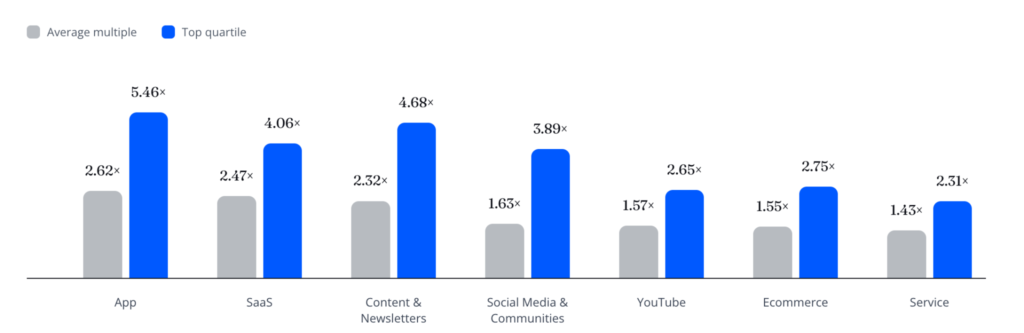
Our H1 2026 Digital Insights data shows the difference good preparation can make: top-quartile Ecommerce businesses sold for 2.75x, compared to 1.55x on average. The work you do now can make all the difference to your exit value.
Use this checklist below as your pre-listing action plan to prepare your Ecommerce business for sale. Work through each step before you list your business, and you’ll be in a stronger position when the first buyer questions start coming through.
Our H1 2026 Insights Report found a clear shift in multiples: average multiples haven’t shifted, but the premium for quality has.
In Ecommerce, top-quartile assets achieved a 2.75x profit multiple versus 1.55x on average on our platform. In fact, in every category where top-quartile data was available, the best assets commanded at least 1.6x above the category average.
Source: H1 2026 Insights Report
Buyers in 2026 are rewarding businesses with higher-quality revenue, durable performance, and defensible growth.
Sebastien Stanley-Jones, EMEA Regional Director at Flippa, says businesses shouldn’t focus on multiples as a whole, but look more into why there’s a widening gap between average and premium assets.
“Average multiples are flat, but I’ve never seen the best assets in a category pull this far away from the rest. Preparation is the multiple now,” Sebastien says.
So, when’s the best time to prepare? We’d recommend at least 90 days before you plan on listing to get everything in order before a buyer even starts inquiring.
Tony Xu, CEO at Flippa, says he’s found every conversation with buyers in 2026 arrives at the same word: Proof.
“[They want to know] Can you prove the revenue repeats? Can you prove the traffic is yours? Can you prove the business survives its founder walking away?” Tony says.
How do you get that proof? Follow our 7-step checklist below to speed up diligence and shorten the distance between listing and sale.
Follow this checklist to prepare your Ecommerce business for sale at least 90 days out to give yourself enough time.
Start with your net profit and add back your owner compensation, personal expenses, one-time costs, and any other eligible expenses a buyer won’t continue after the sale.
That will give you your seller’s discretionary earnings (SDE), which, along with the valuation multiple your business can achieve, gives you a starting point for estimating your sale price.
Use this formula:
SDE = Net Profit + Owner’s Salary/Compensation + Eligible Add-Backs
For a full guide on SDE, head over to our Ecommerce Business Valuation: What Your Store is Worth in 2026 guide.
Pull together 24 months of monthly profit and loss (P&L) statements and separate business expenses from personal spending to remove anything that wouldn’t transfer over to the new owner.
Now’s the time to investigate any unexplained inconsistencies in your finances before a buyer does. You’re working towards making sure a buyer can independently verify your reported earnings without you needing to explain every line.
“The buyers I’m working with want twelve months of clean financials before they’ll even book a call, and the sellers who have them are getting rewarded for it.”
— Marco Reeves, APAC Regional Director at Flippa
Buyers want to know the business will continue running smoothly without its founder. Set your business up for success by documenting the recurring tasks required to run the business without you.
That means including who does what, when they do it, the tools they use, and what happens when something goes wrong across the following:
Break down your revenue and customer acquisition by channel, from organic and paid search through to email and marketplaces, and document your acquisition strategy to show how traffic is generated.
Flag concentration risk, especially if one channel accounts for more than 50% of revenue, and include historical performance to show steps your business is taking to diversify channel mix.
A detailed, organized, and transferable customer database gives buyers evidence of a retained, stable, and loyal base that can drive future revenue for the business.
Make sure to include:
Build a complete inventory of AI tools in use across the business, documenting what each tool does, who uses it, what it costs, and how it contributes to operational efficiency.
And be upfront with your AI exposure. If organic search is a major channel for your business, buyers will want to know how AI search could affect that traffic. Quantify your dependency, track your AI visibility, document what you’re doing to withstand changes.
Source: H1 2026 Insights Report
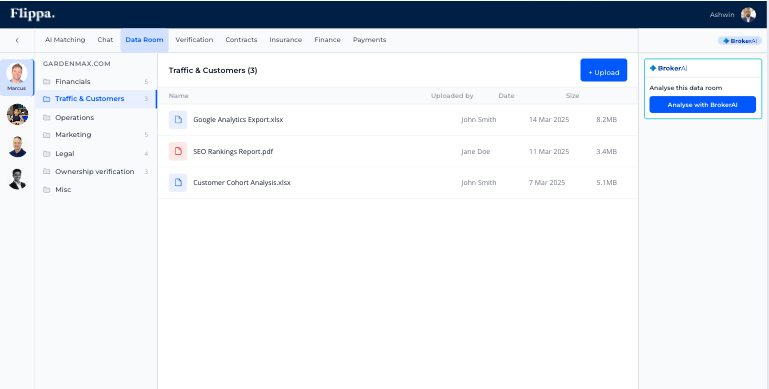
Create a virtual data room before listing to safely house your financials, operations, technology, and other relevant assets.
Organize it into clear folders, with consistent naming and dates so buyers can find what they need instantly. Treat the data room as a living source of truth and update it as a sale progresses.
If you’re selling through Flippa, a virtual data room is included as part of BrokerAI, our intelligence layer for business brokerage. This data room is where you can securely organize and share the information buyers will need during due diligence.
Source: Flippa
Once these steps are complete, you’ll be prepared to answer the buyer questions that come next.
Before you list, pressure-test your business against the areas buyers are most likely to scrutinize.
Buyers will want to verify revenue at the source, not rely on screenshots or seller-prepared spreadsheets. Make sure every revenue figure in your listing can be traced to your Stripe, Shopify, PayPal, Amazon, or other payment processor third-party source.
Buyers will want to easily understand how inventory is treated and identify any slow-moving or potentially unsellable stock upfront. Do an inventory count before listing and flag anything the buyer might consider a write-off risk.
Buyers will want to know the business’ biggest dependencies and quickly see the percentage of revenue and traffic tied to each. Document platform risks, including policy issues or account restrictions, alongside revenue distribution. Be ready to explain risks and what your mitigation plan is.
Buyers will want to see how easily supplier relationships can be transferred in the sale. List your key suppliers and document all terms, pricing, lead times, and payment terms. Get important agreements in writing where possible and flag any suppliers with a significant share of inventory or revenue.
You’ve done the preparation. Now it’s time to find out what the market could value your business at.
Get a free Flippa valuation and benchmark your Ecommerce business against recent sales data. You’ll get an indication of your business’ potential market value, based on a number of factors, including financial performance, growth, and business structure.
Use the valuation as a final sense-check before you list. Does your current performance support the price you’re targeting, or is there still work to do?
From there, you can use your valuation to decide when to list on Flippa, refine your asking price, and start conversations with potential buyers.
Ideally, you should start preparing your Ecommerce business at least 90 days out from listing. This will give you enough time to clean up financials, document operations, address any risks, and build a recent track record buyers can easily verify.
Buyers will often request a number of financial records, including up to 24 months of P&L statements, bank statements, sales data by channel, revenue breakdowns, and inventory records. The important thing to do is to make sure the figures in your listing are accurate and verifiable.
You don’t need one single SOP document to sell your Ecommerce business, but you will need enough documentation to show buyers how the business will run without you. That includes documenting recurring processes that keep the business running, including order fulfillment, inventory management, and customer service.

Hear from business owners and entrepreneurs who have bought and sold online businesses on Flippa.

Search our knowledge base for answers to common questions.