Amazon FBA valuation multiples in 2026: real data from sold deals


Blog


 The Exit Podcast
The financial metrics of your Amazon FBA business can only take you so far towards securing a premium exit. It’s the multiple that determines how your earnings translate into business value.
On Flippa, Amazon FBA businesses fall under the Ecommerce category, which in H1 2026, sold for an average of 1.55x profit, while top-quartile businesses commanded 2.75x.
Getting a premium multiple for your business comes down to proof and preparation. Market conditions establish the range buyers are willing to pay, but your business’s performance, quality, and risk profile determine where your FBA business lands within that range.
In this guide, we’ll look at recent marketplace data to see how Ecommerce businesses are being valued in 2026, the factors that can influence your Amazon FBA valuation, and what sellers can do before listing.
Our H1 2026 Insights Report groups Amazon FBA businesses under Ecommerce for category-level data. For Ecommerce businesses on Flippa, the average profit multiple was 1.55x in H1 2026, while businesses in the top quartile achieved 2.75x.
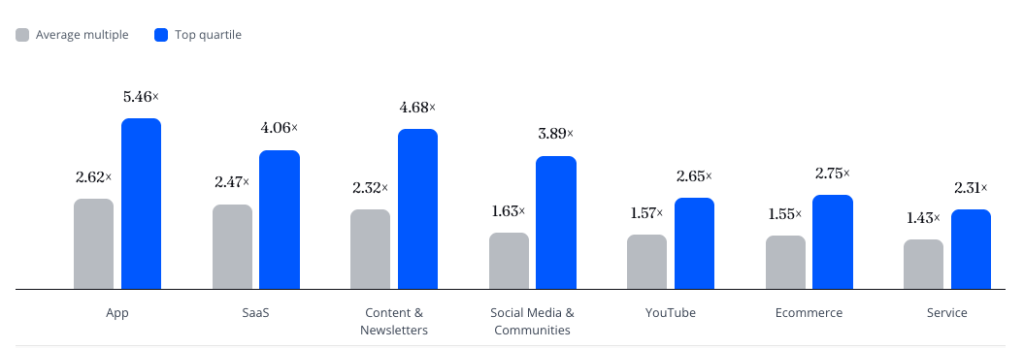
Source: Flippa, H1 2026 Insights Report
When looked at historically, Ecommerce profit multiples softened in H1 2026 compared to the same time period in 2025. Average multiples fell from 1.7x to 1.55x, while top-decile multiples declined from 2.78x to 2.23x.
How profit multiples shifted from H1 2025 to H1 2026
| Timeframe | Average profit multiple | Top-decile profit multiple |
| H1 2025 | 1.70x | 2.78x |
| H2 2025 | 1.69X | 2.79x |
| H1 2026 | 1.55X | 2.23x |
Our H1 2026 Insights Report found the distance between average and top-decile multiples often comes down to your business’ revenue quality, durability, and growth potential. The FBA business owners who can prove this are more likely to get a higher exit price.
Want to know where your store sits? Our free FBA valuation will estimate your store’s value using marketplace data from Ecommerce assets sold in H1 2026.
Amazon FBA businesses can achieve higher profit multiples when sellers can successfully demonstrate their business is profitable, sustainable, and transferable.
Here are some of the signals that can indicate these qualities:
A clean Amazon selling history reduces perceived risk during due diligence. While Amazon seller accounts generally aren’t transferable when the ownership of a business changes, buyers may still want to review the seller’s account health and compliance history.
Things they might look out for include:
Amazon’s Account Health Rating (AHR) gives sellers a near-real-time indication of their account’s risk of deactivation due to non-compliance. Sellers can opt to share their AHR and policy history with potential buyers as part of the due diligence process to help show policy compliance.
A registered trademark and enrollment in Amazon’s Brand Registry can prove the brand has established ownership and protection on Amazon.
Brand Registry provides tools to help brands detect and report suspected IP infringement as well as unique codes to verify only authentic, accurate items are shipped to your customers.
It also gives brands access to Amazon’s brand-building tools, including suggested content for product detail pages (PDPs) and marketing features.
For buyers, clear brand ownership, a registered trademark, and relevant IP can make an Amazon FBA business easier to evaluate and transfer.
Pay-per-click (PPC) advertising (often referred to as cost per click (CPC) on Amazon) helps businesses generate initial sales. However, a long-term dependency on paid traffic carries a different risk profile from one with established organic demand.
Buyers may want to look at the share of sales coming from organic search vs. PPC alongside historical sales, advertising spend, total advertising cost of sales (TACoS), advertising cost of sales (ACOS), and keyword rankings.
A consistently strong Best Sellers Rank (BSR) over time can also prove to buyers your product has sustained demand.
Businesses with earnings spread across several profitable SKUs often attract stronger buyer interest than those building the majority of profit from one SKU.
Spreading earnings across multiple SKUs reduces exposure to risks such as a new competitor entering the marketplace, a supply disruption, or a change in customer demand.
There’s no magic number of SKUs an Amazon FBA business should have in its portfolio. The key thing here is how evenly the distribution of revenue is across SKUs, and whether that mix is consistent and stable over time.
Buyers are actively looking for how AI is being used and the value it can add, with our H1 2026 Insights Report finding searches for ‘AI-powered business’ increased 20% half-on-half.
Amazon FBA businesses with AI tools embedded into repeatable workflows are attractive to buyers, but only if the benefit from those tools is provable.
Sellers should be able to show how AI integrations improve workflows and provide documentation on every tool, explaining what’s being used, how it’s helping improve the business, costs involved, and how those tools are monitored.
A strong supplier network can be a valuable asset for an Amazon FBA business, especially when those supplier relationships are established and well documented.
Buyers will want to know where products come from, how they’re ordered, the terms in place, and the length of time it takes for stock to be delivered. Purchase-order history, supplier agreements, and lead times can all help to demonstrate this.
The same factors that can strengthen your valuation can also work against it if not properly managed or documented.
Here are some of the risks buyers are looking out for when valuing an Amazon FBA business:
The platform a business operates on can introduce additional valuation considerations.
Shopify and Amazon FBA businesses can attract different valuations because buyers are acquiring different levels of control, customer access, and infrastructure.
Shopify gives owners greater control over their storefront, customer experience, and marketing channels. Amazon FBA businesses benefit from Amazon’s established marketplace and fulfillment infrastructure, but operate within Amazon’s platform and customer ecosystem.
These differences can influence how buyers assess the business, its growth opportunities, and the level of involvement needed from a new owner.
A feature comparison of Shopify and Amazon FBA businesses
| Feature | Shopify | Amazon FBA |
| Customer data | Greater control over customer data and relationships | More limited because transactions take place within Amazon’s marketplace |
| Traffic diversification | Owner needs to build traffic across paid, organic, email, and direct | Owner benefits from built-in marketplace traffic |
| Platform dependence | Low platform dependence; Shopify provides infrastructure for owners to build an independent store | High platform dependence; owners list products within Amazon marketplace |
| Brand ownership | Greater control over brand strategy and presentation | Brands can be built on Amazon, but customer experience remains within Amazon marketplace |
| Fulfillment | Independent from Shopify | Handled by Amazon |
These differences can impact how a buyer assesses the quality and durability of a business’ earnings. Neither platform automatically commands a higher multiple. Valuation depends on how each business manages its risks, maintains sustainable earnings, and can be transferred to a new owner.
If you’d like to know how Shopify stores are often valued, read our Shopify valuation multiples guide.
Multiples aren’t static. If you’re looking to list your FBA business, the preparation you do now can have a real impact on your valuation. Here are three steps we’d recommend taking, ideally at least 90 days out from listing.
Check the health of your seller account on Amazon by reviewing:
Document all previous warnings, actions, or suspensions and detail how they were resolved.
Work to strengthen your BSR and reduce reliance on paid advertising before listing.
Reduce paid-traffic dependency by:
Record all supplier agreements in one place, including:
Keep all purchase orders and supplier communications organized and accessible so buyers can understand the existing relationship and how supply can be maintained post-acquisition.
Our quick and easy Amazon FBA sale checklist gives you everything you need to do to get your store ‘sale-ready’ before listing.
Water filtration brand Weeplow built a strong brand by selling products backed by registered trademarks and credible lab testing.
The brand went on to become a category leader in France, with best-selling products and a loyal, retained customer base.
At listing, the company generated €3.5M in annual revenue and €1.45M in annual profit with a 41% profit margin. It sold in 2025 for $3.7M.
The numbers:
The business had stable BSR, strong supplier relationships, and a profitable product portfolio at the time of sale.
Read the full case study here.
Ecommerce multiples provide a useful benchmark for understanding how buyers assess profitability, growth potential, and scalability.
Want to see where your FBA business sits against similar businesses? Use our free FBA valuation to get an estimate of your store’s value using marketplace data, including the latest sold deals in H1 2026.
Knowing where your business stands can help you identify opportunities to strengthen its value before you decide to sell your Amazon FBA business.
Amazon FBA business multiples fall under the Ecommerce category on Flippa. Our H1 2026 Insights Report found Ecommerce businesses averaged a 1.55x profit multiple, with top-quartile businesses reaching 2.75x on our marketplace.
Your store’s profit multiple will depend on a number of factors, including profit, growth, brand strength, and owner involvement.
FBA multiples, when considered within the Ecommerce category on Flippa, are lower in H1 2026 compared to H1 2025. Average multiples fell from 1.7x to 1.55x, while top-decile multiples declined from 2.78x to 2.23x.
Brand Registry can support an FBA business’s valuation because it can indicate to buyers established brand ownership and gives business owners access to tools for protecting and building their brand.
However, it is only one factor in the valuation process, with traffic, profitability, and account health also playing key roles.
Generally, there isn’t a fixed multiple that applies to both FBA and Shopify businesses based on the platform alone. Both are assessed on factors such as sustainable growth, risk, and transferability.
Each platform offers different benefits and risks, which can influence how a buyer assesses the durability of a business’ earnings over time.

Hear from business owners and entrepreneurs who have bought and sold online businesses on Flippa.

Search our knowledge base for answers to common questions.