How to Sell an Ecommerce Business (2026 Edition)


Blog


 The Exit Podcast
If you’re planning to sell an ecommerce business, there’s a lot of preparation that goes into the process, from putting together the right documentation through to valuing the store, finding a buyer, and eventually transferring ownership.
The good news is that it doesn’t have to be a daunting process. You can put yourself in a great position if you prepare your store and your finances ahead of time, so you’re ready when serious buyers start asking about your business.
Now’s the time to get started. Buyer activity is strengthening, with our H1 2026 Insights Report showing 123,000 active buyers on Flippa, up 18% year-over-year. And with an estimated $120 billion in available acquisition capital across our registered buyer pool, the work you’ve put into building a successful ecommerce store has the potential to pay off.
In this guide, we’ll walk through everything you need to know to sell your Ecommerce business, including a deep-dive into how to get your store ready for market, plus a step-by-step guide of what the selling process looks like.
Pulse Check: Ecommerce Business Sales in 2026
Calculating the Worth of Your Ecommerce Business
How To Prepare Your Ecommerce Business To Get The Best Price
How to Maximize Your Sale Price
The 6-Step Selling Process — From Valuation to Close
Before we dive into the practical steps to sell your Ecommerce business, let’s look at the trends shaping digital mergers and acquisitions (M&A) on Flippa, from our H1 2026 Insights Report.
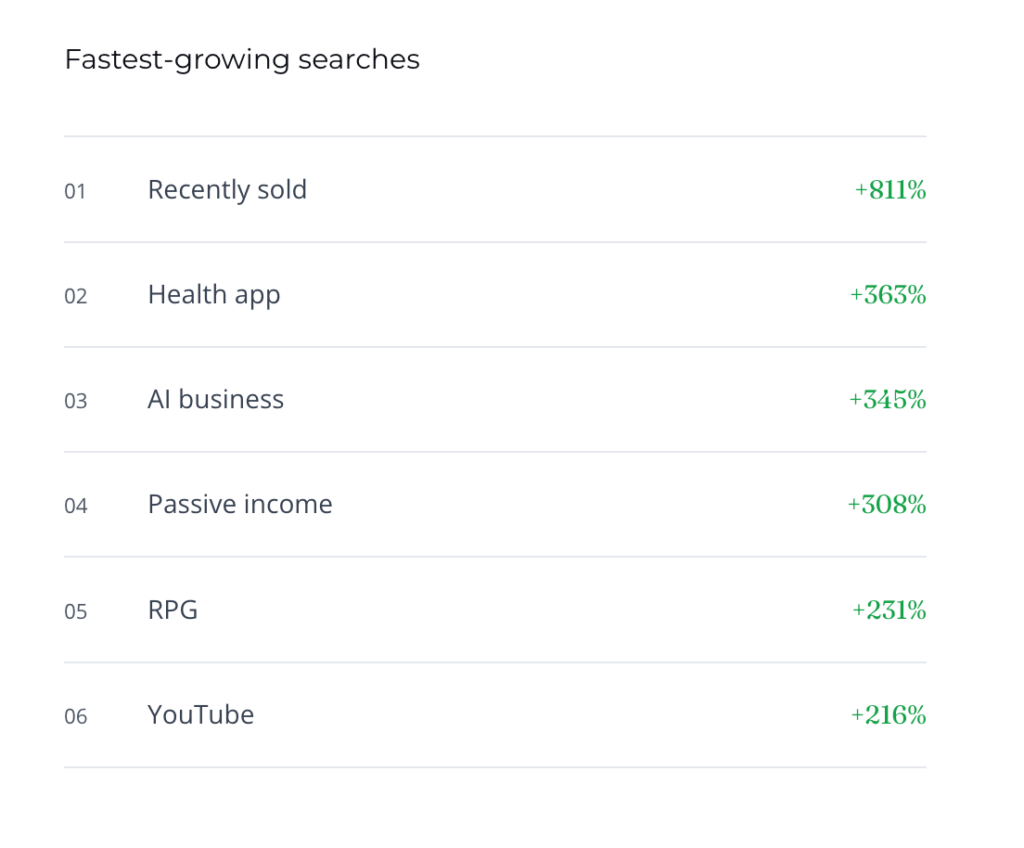
Searches for ‘recently sold’ jumped 811%, making it the fastest-growing search term on our marketplace. This suggests buyers are focused on comparable evidence over asking prices.
For sellers, this means pricing with comparable completed transactions in mind, rather than relying solely on what you believe your site to be worth.
Source: H1 2026 Insights Report
Ecommerce accounted for about a third of valuation activity on Flippa for H1 2026, suggesting a substantial pipeline of businesses coming to market.
However, Ecommerce sold deals were down 2.3%, which signals a market where buyers are becoming more discerning. Buyers want proof, not potential. Sellers with reliable revenue, clean financials, and documented operations are better positioned to stand out.
Source: H1 2026 Insights Report
Let’s say two Ecommerce businesses generate similar profits. On paper, they look almost identical. However, when a buyer starts digging into the numbers, operations, and customer base of each, the difference between those two stores can become significant.
That difference is showing up in today’s market. The average Ecommerce businesses achieved a 1.55x profit multiple, while top-quartile businesses reached 2.75x. That gap is significant. And the driving factor behind it, from what we’ve seen, is preparation.
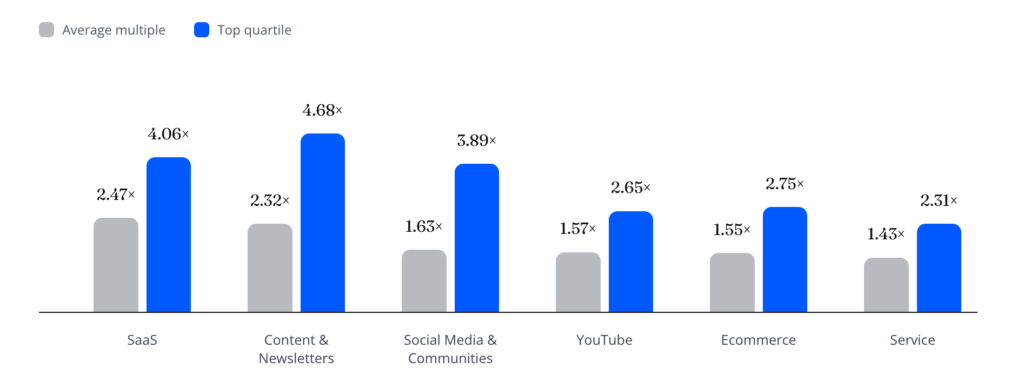
Source: H1 2026 Insights Report
If you want to know where your business would land, and what a buyer would see when they put value on it, first we need to start with the numbers that underpin a valuation.
For owner-operated businesses, the seller’s discretionary earnings (SDE) method is commonly used to show a prospective buyer a business’ underlying earning power. It forms the basis of the valuation calculation.
The formula is:
SDE = Net Profit + Owner’s Salary/Compensation + Other Eligible Add-Backs
For example, a business with $100,000 net profit, $60,000 owner compensation, and $5,000 in add-backs from personal travel to a conference would have $165,000 in SDE.
Owner salaries and eligible add-backs are expenses specific to the current owner that mightn’t continue under new ownership.
For a full breakdown of how Ecommerce businesses are valued, read our Ecommerce Business Valuation guide.
Once you’ve calculated SDE, you can apply a valuation multiple to estimate what your Ecommerce business could be worth.
A valuation multiple is a number that’s applied to a business’ earnings to estimate its market value.
For example, an Ecommerce business with $165,000 in SDE and a 3x multiple would have an estimated value of $495,000.
But the multiple isn’t one-size-fits-all. It can vary depending on factors such as deal size, financial performance, and the overall quality and stability of the business.
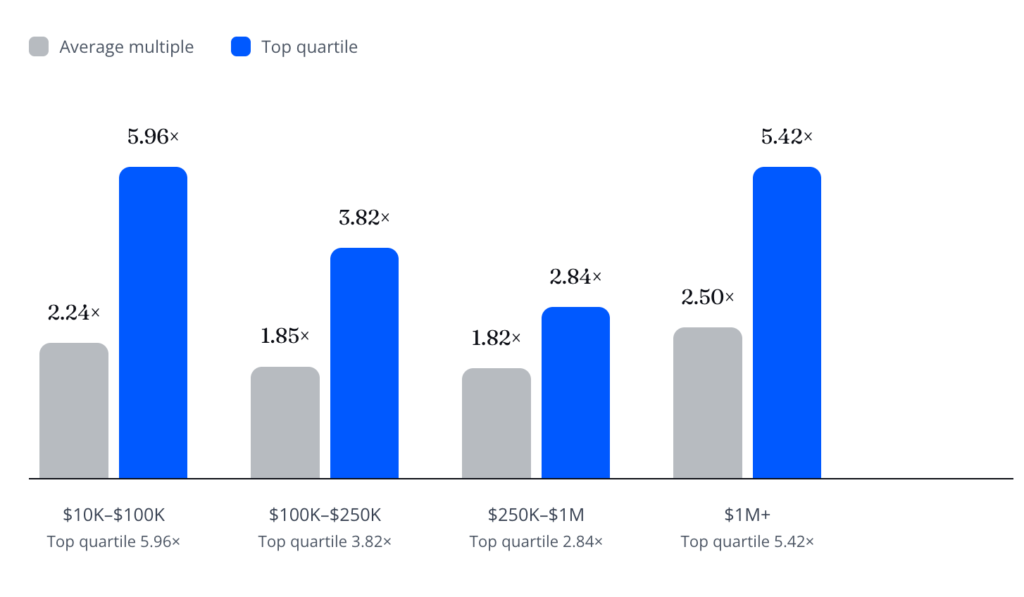
Our H1 2026 Insights Report found multiples were strongest at both ends of the market: $10K–$100K (likely reflecting a mix of high-growth, early-stage assets) and $1M+ (where larger assets are relatively scarce).
Source: H1 2026 Insights Report
The gap between the average of top-quartile multiples expanded in H1 2026, suggesting buyers are valuing the qualities of the best-performing assets: revenue quality, durability, and defensibility.
For sellers, these characteristics provide a useful benchmark for understanding what buyers are looking for and where there might be gaps to address before going to market.
Source: H1 2026 Insights Report
See what your business could be worth with a data-backed estimate before you decide to list.
Get a free Ecommerce business valuation
Knowing what buyers value is one thing. Making sure your business demonstrates those qualities is something else entirely.
Before you put your online business on the market, you’ll need to prepare it for sale. This can help position your business for the best possible price.
Preparation requires a number of steps, including organizing your financials and customer data, establishing your standard operating procedures (SOPs), and updating your inventory.
If there’s one aspect of your business that can hamper your prospects of achieving a sale you’re happy with, it’s disorganized financials.
Disorganized financials mean you don’t truly understand the financial position of your Ecommerce store. And if you don’t understand it, a prospective buyer won’t have a grasp of your relative growth in net income, the relative size of your business, and its prospects of scaling. You simply won’t get the price you’re looking for.
We recommend working with your accountant to ensure you have a 24-month view of your business. Typically, sellers will have:
SOPs (or standard operating procedures) are guides that help your staff perform their tasks to the best of their abilities in a way that’s efficient and productive, and for the benefit of your overall operations.
When you establish SOPs, you’re essentially detailing steps and procedures that’ll make life far easier for the next owner. They won’t have to establish SOPs themselves, and they won’t have to take over a team that’s fumbling around in the dark. Instead, everyone will know what needs to be done, as well as how to do it.
SOPs can also enhance your reputation, demonstrating you’re a reliable brand that’s committed to efficiency and consistency.
What areas of your business should you create SOPs for?
When you write up your SOPs, don’t forget to keep everything simple and clear so your guidelines are easy for everyone to understand. Also, make sure that your format is consistent. This will further improve readability.
Before you put your online business up for sale, it’s critical that your inventory is on track. This means:
To help you update your inventory so it’s ready for sale, it’s a smart idea to invest in inventory management software. This will help you perform an inventory audit, assess your supplier performance, and generally stay on top of your stock, all of which will help to bump up the price of your store.
Make sure to remove products from your website that you’re no longer selling and consider reducing the number of categories if you feel that there are too many.
Customer data has been a big topic for a while now. Ecommerce businesses collect large amounts of information on their customers, which is typically used to enhance the customer experience and grow the store.
Because this data is essential to the success of your business, it’s important to get on top of it.
In addition, organizing your customer data will help to make your Ecommerce business more appealing to potential buyers. They’ll be able to take over your business and continue your marketing campaigns without starting again from scratch.
Organize your data into different segments, such as marketing, sales, and customer service, and remove any irrelevant data. Retain the data that helps with forecasting, but make sure to discard superfluous data that doesn’t help with targeting.
Your supplier relationships are an integral part of your Ecommerce business. Potential buyers will want to know how you source products and identify opportunities for new products.
Sorting out this key supplier data early on shows buyers confidence that these relationships can continue after acquisition.
However, for some owners, supplier relationships are personal, or suppliers might have minimum order commitments that aren’t realistic or transferable to a new owner. This can be a deal breaker. If a buyer isn’t confident they can maintain the same suppliers, pricing, and product access post-acquisition, it can make them reconsider the deal.
To reduce the risk, document key supplier relationships, confirm transferability of existing agreements, and identify alternative suppliers, where possible.
Add the below information into one centralized location so the buyer can easily review it during due diligence:
Getting this information organized ahead of listing can make it easier for buyers to quickly understand your sourcing and product development strategy, and assess how smoothly they can take over.
AI has shifted how Ecommerce businesses operate. AI tools are now used across multiple business operations, from customer service through to marketing and inventory management, automating tasks that once required hours of manual work.
AI tools such as Claude can help with customer service and analysis, while Zapier can automate repetitive workflows between your different systems.
Look for opportunities to automate tasks across:
For a buyer, AI tools matter for two reasons. First, a business that’s using AI automation effectively is often more efficient and less dependent on its owner. This is a lucrative selling point for potential buyers, with our data reporting searches for ‘AI-powered business’ on our site were up 20% for H1 2026.
Make sure to document the AI and automation tools you use. Record what each tool does, costs, and how it fits into your workflow. This gives the buyer a clearer picture and makes the transition easier.
Second, buyers will want to know how exposed the business is to changes brought about by AI, and whether there are opportunities to use AI to improve operations further. Quantify your dependency, track your AI visibility, and document what you’re doing to withstand changes.
The more sales you generate, the more valuable your Ecommerce business will be.
If you, the business owner, are able to demonstrate to potential buyers that you have a clear growth trajectory, this is attractive. Buyers will feel confident they will be able to continue generating traffic from the same sources, while continuing to clinch sales. As such, your store will be worth more when it comes time to sell it.
Sales and traffic largely go hand-in-hand. The more you’re able to drive consistent, qualified traffic to your online store, the more sales you’ll land.
It all comes down to your marketing and advertising channels. This will determine your position on Google, which is essential for organic traffic, as well as your ability to reach customers via channels like email and social media.
Before you put your store up for sale, make sure you’ve covered the bases when it comes to:
This’ll help you show clear and consistent avenues of traffic, both organic and paid, that’ll assist the new owner when it comes to making more sales.
A prospective buyer will likely ask you questions about your marketing strategies and your traffic sources. Show buyers your traffic is sustainable by building a diverse mix of traffic sources.
Also, if you take a look at your traffic data and realize that your site isn’t growing in authority right now, or there are no positive trends, it might be too soon to put your store up for sale.
Make sure to maintain historical data on your web traffic, too. Tools like Google Analytics can help with this.
Getting your revenue growth in order is one piece of the puzzle. For a quick and easy rundown of what you need to prepare before listing, check out our Ecommerce Business Sale Checklist and work through each step to get your business sale-ready.
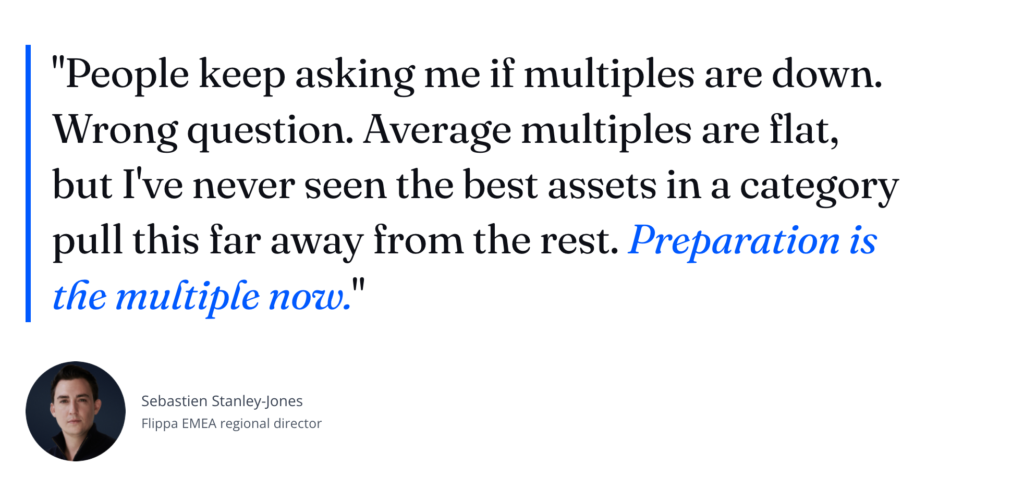
Ecommerce businesses that invest in preparation before going to market are more likely to command higher multiples. In a market where the best-performing assets are pulling away from the pack, Sebastien Stanley-Jones, EMEA Regional Director at Flippa, says preparation can make the difference.
“Average multiples are flat, but I’ve never seen the best assets in a category pull this far away from the rest. Preparation is the multiple now,” Sebastien says.
If you want to put your business in the strongest possible position, take action on these three factors:
1. Reduce owner dependency. Show buyers the business can run without you. Document your processes and knowledge, delegate key responsibilities, and automate repetitive tasks where you can. The less the buyer has to rely on the founder, the more transferable the business is.
2. Prove traffic diversity. Let buyers know your revenue isn’t dependent on a single channel. Show how customers can find you across organic search, paid advertising, social media, marketplaces, and other channels. A diverse traffic mix gives buyers greater confidence the business can stand up to changes on any one channel.
3. Build a virtual data room (VDR): Make it easy for buyers to conduct due diligence by organizing your key information in one secure, centralized space. A VDR allows authorized buyers access to important information, such as financial records and supplier agreements without needing to search through scattered files.
A VDR also helps you respond to buyer requests efficiently while also ensuring compliance with data protection standards.
If you’re selling through Flippa, a virtual data room is included as part of BrokerAI, Flippa’s AI layer for business brokerage. This gives you a dedicated space to organize and share information during the sale process.
You’ve gone the extra mile to maximize your sale price, which means it’s now time to start the selling process.
These six steps will help you find the right buyer at the right price.
There are two ways to get an estimate of how much your Ecommerce business is worth. The first is to do it manually, calculating your SDE and then applying a valuation multiple to it.
The second is to use a valuation tool to calculate your business worth for you. We offer a free valuation tool that draws from thousands of sold sites across our global platform to instantly give you a clear indicator of price.
Due diligence is paramount when it comes to the buying and selling process of an online store. It’s naturally more important for a buyer because they’re the ones who are taking a risk by purchasing your store. As such, they will have questions to ask you about things like your:
To ensure you get the right price for your business and manage to get a sale over the line, don’t enter into negotiations until you understand your business inside and out.
This means you’ll need to be intimate with absolutely everything about your store, from your content marketing campaigns to your fulfillment.
Nick Carlucci, Business Broker at Flippa, says putting in time at this stage of the sale process helps to speed up the time-to-sell timeline, with our transaction data showing a median close time of 84 days for $1M+ deals.
“The seven-figure end of this market is not slow, it’s thorough. I’m matching million-dollar deals with buyers in under a month. What takes time is diligence, and that’s time well spent for everyone at the table,” Nick says.
Selling your online store for the first time is incredibly challenging, and it’s even more challenging if you can’t raise awareness that your store is even for sale. First, you need to understand what buyers are looking for; then you need to find the buyers.
While there are prospective buyers out there looking to purchase online stores, they won’t know yours is available unless you approach the market.
This is one of the biggest benefits of selling on our platform. We have the largest pool of buyers looking for digital assets in the world.
There are two ways you can sell on Flippa:
Brokers have access to networks of prospective buyers. They’ve also sold businesses just like yours before, and they know how to get a deal over the line. Brokers typically work on commission and help you through the entire process, from valuing your business to finding a buyer.
You can also leverage your existing connections. It’s not, however, recommended that you spread the word on social media, as this can catch the attention of your customers and impact brand perception.
Lots of people might put bids in for your business, but not all of them will be qualified prospective buyers.
What do qualified potential buyers look like?
Ask these questions to qualified buyers:
Asking these questions will help eliminate any time wasters, allowing you to move forward to the negotiations stage as quickly as possible.
All deals can be negotiated. Get a good deal? It can still be negotiated. Get a bad deal? You owe it to yourself to negotiate.
It’s highly likely an opening offer will be underwhelming. That’s fine. It leaves room to negotiate. What’s important to understand at this stage is that a potential buyer isn’t coming from the same place that you are. As such, there’ll be a few discrepancies.
The negotiation stage can be tricky. Here are some tips:
To ensure the transition goes as smoothly as possible, you need to leave no stone unturned. You also need to be organized and have all the right documentation ready to hand over to the new owner.
Things you’ll need to transfer include:
You might also come to an agreement with your buyer where you stay on for a fixed period of time once the sale is complete in order to help them adjust to your business.
The six-step process for selling Ecommerce business assets is generally the same regardless of where your store operates. All Ecommerce business owners need to understand what their business is worth and list it on a global marketplace.
However, depending on the platform you run your business on, the final stages can look a little different. Before you agree to a deal, make sure you know what can be transferred, what needs to be migrated, and which requirements your specific platform needs for the transaction to go through.
Selling a Shopify store? You’ll need to consider a few factors before transferring ownership, including your Shopify account, apps, and third-party integrations.
For a step-by-step guide to the process, see our comprehensive guide on How to Sell a Shopify Store.
Selling an Amazon FBA business? You’ll need to factor in a few considerations, including your Amazon Seller account, advertising, and account-related details.
For more detail, see our guide on How to Sell an Amazon FBA Business.
With Ecommerce market revenue projected to reach $3.86tn this year, it’s no secret that the industry represents big business right now. If you’ve decided it’s time to sell, you need to make sure your business is ready to fetch the best price possible.
It all starts with good preparation. When your finances and operations are in order, and you’re ready to navigate due diligence before you even get your first buyer questions, you’ll be in a stronger position to negotiate and close with confidence.
Not sure what your business could be worth? Get a free Ecommerce business valuation based on real marketplace data and use that insight to help inform your asking price.
When you’re ready to sell, list on Flippa and get your business in front of qualified buyers actively looking for Ecommerce businesses to acquire.
Whether you’re just exploring a sale or preparing to list your business, these guides will dive deeper into the process, from valuation through to closing.
To sell your Ecommerce business, you’ll need to calculate what your business is worth and then get your business sale-ready by organising financials and documentation, updating inventory, and addressing AI tools and potential AI exposure.
The average multiple for an Ecommerce business is 1.55x, according to our H1 2026 Insights Report, which takes profit multiples from historical deals sold on Flippa.
There’s no set timeline for selling an Ecommerce business. The timeline depends on factors like asking price, business performance, buyer demand, and how prepared your business is for due diligence. Our data shows the median time to sell for digital businesses ranges from 43 to 84 days across price bands.
Qualified buyers are looking for proof that your revenue is stable and repeatable, that your traffic is diversified, and that your business can run independently. Putting time into preparing financial records, documenting your SOPs, and keeping your inventory in order all make it easier for buyers to assess your business.

Hear from business owners and entrepreneurs who have bought and sold online businesses on Flippa.

Search our knowledge base for answers to common questions.