Ecommerce Business Valuation: What Your Store is Worth in 2026


Blog


 The Exit Podcast
aluing an Ecommerce business means estimating what a buyer could reasonably pay based on a number of factors, from earnings and growth to takeover risks.
When buyers assess an Ecommerce business, they’re looking at the strength and sustainability of its earnings, its customer base, its diversification of suppliers and channels, and owner dependency.
An Ecommerce business is typically valued using the formula:
SDE x valuation multiple = Estimated business value
However, this formula only tells part of the Ecommerce business valuation story. The quality of the business is what really determines its value. Two stores generating the same revenue and profit can be worth very different amounts, depending on a range of factors, from growth trajectory to supplier relationships.
In this guide, we’ll cover how Ecommerce businesses are valued in 2026 using real-world data, the factors that can increase or reduce your business’s value, and what you can do to strengthen your position before you sell your Ecommerce business.
SDE measures the earnings of your business and is used during mergers and acquisitions (M&A). It’s used as a cash flow metric to show potential buyers the underlying earning power of your business.
SDE is calculated as:
SDE = Net Profit + Owner’s Salary + Other Eligible Add-Backs
Add-backs are bottom-line expenses related to the business that won’t necessarily carry over under new ownership. Examples of eligible add-backs include:
Operating expenses that will continue under new ownership aren’t considered an eligible add-back expense. That includes expenses such as:
For example, let’s say you run a business with a net profit of $200,000. You typically pay yourself $100,000 annually, and in the past financial year, you attended a three-day conference in Germany, which cost $7,000.
When adding back those expenses, you’d have an SDE of $307,000.
If you own a growing online store, the trailing 12-month (TTM) SDE can better reflect your business’ current earning power. It measures your SDE over the most recent 12 months, giving buyers a clear picture of what your business is generating today.
For a seasonal or more volatile store, a three-year average SDE often provides a clear view of sustainable earnings by smoothing out strong or weak periods.
TTM shows where your business is now; a three-year SDE average shows whether your business is sustainable over time. Buyers may want to see both.
Getting your SDE calculation right matters because it lays the foundation of your valuation. Once you have your SDE, you can then apply an Ecommerce valuation multiple based on comparable Ecommerce businesses and recent market transactions to estimate what your business could be worth.
That makes an accurate SDE especially important because every dollar you add or subtract to calculate your SDE can have an amplified impact on your business’ estimated value.
The next step is to see how that earnings base translates into market value.
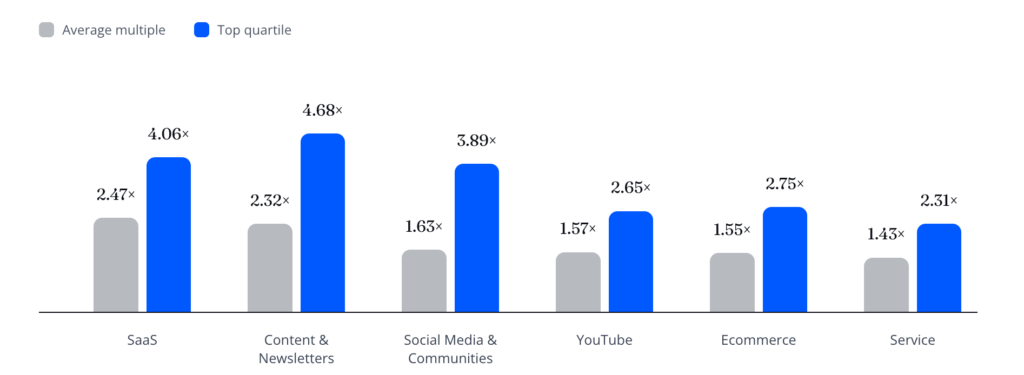
Our H1 2026 Insights Report found top-quartile Ecommerce businesses achieved a profit multiple of 2.75x, compared with an average of 1.55x.
What does that look like in practice? Let’s take the $307,000 SDE from earlier and apply it across the average and top quartile multiples.
Estimated business valuation using average and top-quartile multiples
| Multiple | SDE | Estimated valuation |
| 1.55x | $307,000 | $475,850 |
| 2.75x | $307,000 | $844,250 |
This spread between average and top-quartile multiples isn’t just limited to Ecommerce businesses, with the best assets on Flippa commanding at least 1.6x the category average. This shows how strongly buyers are willing to reward quality, durability, and defensible growth.
Source: H1 2026 Insights Report
The takeaway here is to focus on the quality of your earnings, not just the size of your business. Clean financials, documented operations, and lower owner dependency all go towards helping position your business for a stronger valuation.
The sale of water-filtration brand Weeplow is a great example of what this looks like in practice. The company generated approximately €3.5M ($4M) in annual revenue, €1.45M ($1.68M) in profit, and had a 41% profit margin when it listed on Flippa.
But the strength of this business went beyond its financial records. Weeplow also had diversified distribution, a repeat-driven customer base, and a lean operations setup with 10 SKUs and two long-term suppliers.
This gave the buyer multiple reasons to view the company as sustainable, resulting in Weeplow being acquired for a low-to-mid seven-figure sum on Flippa in 2026.
Valuation is a reflection of the quality, durability, and transferability of a business’ earnings. Increasingly, buyers are looking at sold deals to judge what those qualities are worth.
Here’s what you can do to make your business more valuable and increase buyer confidence in the earnings behind your valuation.
Your valuation ultimately comes down to how confident a buyer is that the earnings they’re paying for now will continue after the acquisition.
And that confidence is shaped by more than your latest profit figure. Buyers will likely assess a range of factors, including growth trajectory, customer base, and whether systems and operations are easily transferable.
These factors don’t produce a fixed multiple. They help determine how a buyer perceives the quality and risk of your earnings. Ultimately, it helps determine what they may be willing to pay for them.
Here are seven factors that can influence your Ecommerce valuation multiple.
A prospective buyer isn’t looking at your revenue as a static figure. They’re after consistent, repeatable growth. A business bringing in $500K, $600K, $720K in revenue over three years tells a very different story from a business generating $500K, $1.2M, and $720K over the same period.
Both businesses have the same current revenue, but the second shows greater volatility. This can create uncertainty around whether the current level of revenue can be sustained.
If 95% of your traffic comes from Google organic search, a major algorithm change or shift in search behavior could put your traffic (and potential revenue) at risk.
That risk is becoming more tangible with AI models. The presence of Google’s AI Overviews correlates to a 58% lower average click-through rate for the top-ranking page, according to SEO software platform Ahrefs.
A more diversified traffic stream across paid search, email, and other channels can help soften the impact if or when one channel slows down. It also gives buyers greater confidence that your acquisition funnel isn’t dependent on a single channel.
A highly profitable business with one reliable acquisition channel can still be attractive to a potential buyer. The owner just needs to prove the channel is durable and the business has a credible path to continued growth.
Having a robust customer database helps Ecommerce teams make real decisions that directly impact buyers, from personalized shopping experiences through to targeted marketing campaigns.
This can drive up the perceived value of a business, especially when a seller can clearly prove their business has a strong (and transferable) customer database.
Metrics that can show a steady and healthy customer base include:
If 80% of your products come from one supplier, you’re indicating to prospective buyers they’d be investing in a dependency that might not be flexible enough to handle change.
In this situation, a buyer will want to know how easily that supplier relationship can be replaced or changed. If your supply chain is concentrated within a single country or region, changes to trade agreements or import restrictions can significantly impact your bottom line (and impact how a prospective buyer values your business).
The harder it is to replace a sole supplier, the greater the potential risk to future earnings. A well-documented and diversified supply chain can give buyers confidence your business can continue to generate revenue.
Buyers will want proof an Ecommerce business can stand on its own when its founder or owner leaves. To prove this, you should establish standard operating procedures (SOPs) and build documentation to detail steps and procedures that will make life easier for the next owner.
This also helps you spot any areas where the owner has outsized input into the running of the store. Taking the time to delegate tasks and removing yourself from regular workflows as much as possible indicates the business can run smoothly, regardless of who’s in charge.
This signals to buyers they’d be able to take over the running of the business smoothly, making independence from an owner part of the overall valuation.

Source: H1 2026 Insights Report
AI has become a diligence consideration, with buyers alert to businesses both exposed to AI disruption and using AI to optimize workflows.
Businesses that prove they can weather AI exposure with diverse revenue channels that expand beyond organic search will have a competitive advantage.
Businesses using AI as an effective tool to drive efficiency and reduce owner dependency will also be lucrative for potential buyers. Data from our H1 2026 Insights Report shows searches for ‘AI-powered business’ on our platform increased by 20%.
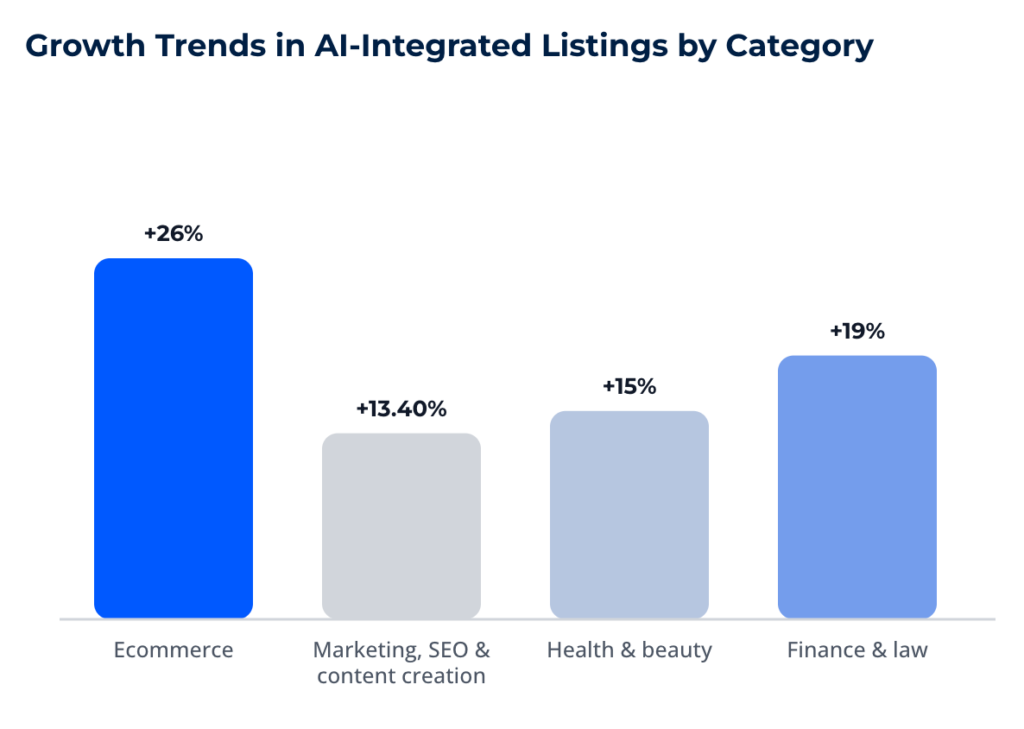
AI-integrated listings grew across every category on our platform, with the strongest growth coming from Ecommerce (26%), indicating AI is now being valued as an operational advantage across the board.
Source: H1 2026 Insights Report
The age of your business can also be a value signal for sellers, indicating your store is durable and long-lasting. Our H1 2026 Insights Report found Ecommerce businesses sold on Flippa at an average age of five or more years.
And while age is a consideration in perceived value, it isn’t everything. A 10-year-old mediocre business isn’t automatically worth more than a three-year-old exceptional business.
For example, Australian automotive Ecommerce brand The Cruiser Store was founded in 2023 and exited for $2.2M just 30 months later on Flippa.
Its relatively short operating history was offset by a healthy repeat customer rate, a staggeringly high return on ad spend (ROAS), and a business structure designed to operate without heavy founder involvement.
The Cruiser Store case study proves that business maturity is only one piece of the valuation process. What matters is the evidence behind the earnings and how confidently a seller can step in and keep the business running.
Where and how your Ecommerce business operates can also shape the risks a buyer takes or the assets they’re acquiring, plus the evidence they’ll want to see during due diligence.
Not all Ecommerce businesses are assessed in the same way. A Shopify store, an Amazon FBA business, and a multi-channel operation all have different sources of value a buyer will assess.
For Shopify businesses, the storefront is only a small part of what a potential buyer will gain. They’ll want to know how defensible your business’ brand is beyond the platform.
Key areas to consider are:
For a deeper dive, see our comprehensive guide on How to Sell a Shopify Store.
Fulfillment by Amazon (FBA) businesses are attractive to buyers because they can scale quickly and come with established processes. However, it’s important to note here that Amazon seller accounts generally aren’t transferable.
Ownership changes either through a stock or equity sale, where the legal entity stays the same and you update account details, or through an asset sale, where the buyer opens their own seller account and you migrate listings and brand registry roles.
For most FBA exits, buyers look at a clean 12 to 24 month window, normalized for add-backs and seasonality. Factors like age of business, financial performance, and owner involvement all contribute to the perceived value of the business.
For a deeper dive into valuing an FBA business, take a look at our full guide on How to Sell an Amazon FBA Business.
Selling across multiple channels can reduce platform risk, but only if the additional channels don’t create additional operational risk.
A business generating revenue through Shopify, Amazon, and wholesale can be more resilient to sudden platform-specific changes. However, buyers will want to know whether those channels are all genuinely profitable, and whether a transfer of ownership can be done without adding more complexity to the process.
Look at:
Know the data-backed estimate of your business’s market value before you decide to sell.
Get a free Ecommerce business valuation
Understanding what influences valuation is one thing. Improving those factors before you list is where sellers create real value.
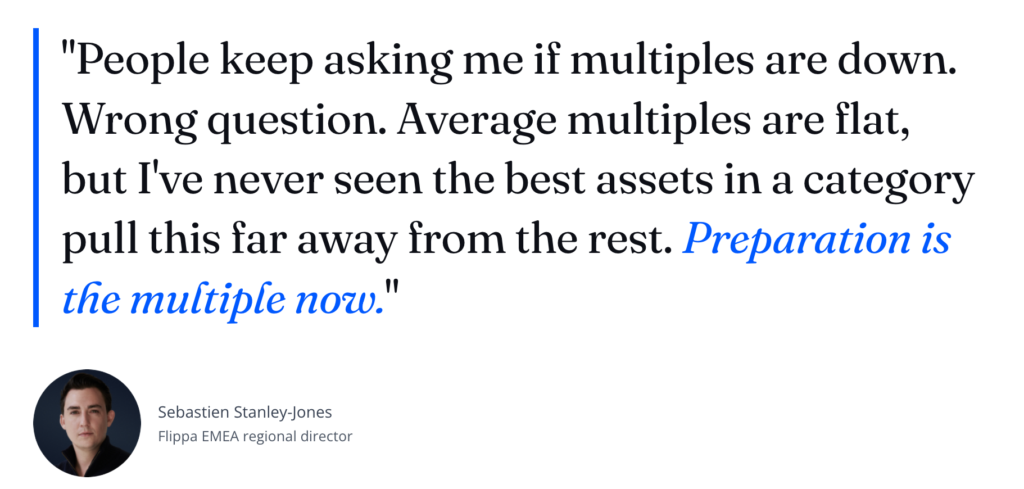
The strongest opportunities to increase your valuation come from reducing buyer risk and uncertainty through in-depth preparation. That means making earnings predictable, diversifying revenue, and tightening operations to make ownership transfer easy.
Source: H1 2026 Insights Report
The period before you list is an opportunity to move the needle on metrics and proof points buyers will look to when assessing your business. Focus on improvements that can show up in your trailing 12-month earnings.
Diversify traffic and suppliers where practical, clean up your financial documents, set up SOPs, resolve account issues, and organize customer data.
In H1 2026, ‘recently sold’ was the fastest-growing search term on Flippa, increasing a staggering 811%. Understanding the price benchmarks of comparable online stores can help you set a more credible valuation and identify opportunities to add value.
It’s important to remember that your valuation is a market-informed benchmark and not an indication of your exact business worth. For example, if your SDE is $200K and the multiple is 2.5x, your business valuation is $500K, but that’s not exactly what your business is worth.
The actual price can differ for a range of reasons, including buyer competition, diligence findings, and inventory treatment.
If you’re ready to list your Ecommerce store, we’ve put together an Ecommerce Business Sale Checklist you can use to make sure you’re prepared well before your first buyer questions.
There’s no single magic number that applies to every Ecommerce store. Your valuation depends on a number of factors, from the quality of your earnings to the durability of your customer base and operations.
The best way to understand where your business sits is to benchmark it against real Ecommerce businesses that have already sold.
With our free Ecommerce business valuation tool, you can get an instant estimate of your store’s value based on comparable marketplace data, including H1 2026 sold deals.
Know where your business stands before you list, and identify what you can do to strengthen its value before you sell your Ecommerce business.
The average multiple for an Ecommerce business in 2026 is 1.55x, according to our H1 2026 Insights Report. The top quartile reached 2.75x.
Ecommerce businesses are generally valued on profit over revenue, because profit provides a clear picture of the cash flow and earnings the business generates. Revenue matters, but primarily in terms of the scale, growth, and quality of the business.
An Ecommerce business can be worth more when it has sustainable earnings and low perceived risk. Consistent growth, healthy margins, and diversified traffic and suppliers can all increase buyer confidence and help boost your valuation.
Flippa’s free valuation tool provides an estimate based on recent marketplace data and comparable transactions instantly. A more tailored valuation can take longer because it requires reviewing your business’ customer data, financial performance, and other factors that influence a buyer’s perceived value.

Hear from business owners and entrepreneurs who have bought and sold online businesses on Flippa.

Search our knowledge base for answers to common questions.