A Complete Guide To Preparing a High-Ticket Dropshipping Store for an Exit


Blog


 The Exit Podcast
Most people build a high-ticket dropshipping store to create income and freedom, and almost nobody builds it with the ending in mind. That is a costly mistake. The store you run today is also an asset you can sell later, and the difference between a rushed fire sale and a clean, well-prepared exit can be tens or even hundreds of thousands of dollars. I have built and sold multiple six and seven figure stores over the last 15 years, and at Ecommerce Paradise I teach entrepreneurs to treat their store like a business they could hand to a buyer at any moment, because that mindset makes you more money whether you sell or not.
If you run a high-ticket store and think you might sell it one day, this guide is for you. I will walk through exactly how buyers value a store like yours, what to fix in the 6 to 12 months before you list, why Flippa is the smartest place to actually sell, and the mistakes that quietly kill deals during due diligence. The work starts long before the listing ever goes live.
Buyers do not pay for revenue, they pay for profit and how reliable that profit looks going forward. The standard formula for a store your size is a multiple of Seller’s Discretionary Earnings, or SDE, which is your net profit plus add-backs like your own salary, one-time expenses, and personal costs run through the business. A store doing $60,000 a month in revenue at a 10 percent net margin throws off roughly $72,000 in SDE a year, and at a 3x multiple that is a $216,000 sale. Move the multiple from 2.5x to 4x through preparation and the same store sells for $288,000 instead of $180,000. That gap is the whole game. Flippa’s own breakdown of how to value an ecommerce business walks through the same math step by step.
The multiple is not random. It reflects how risky your profit looks to a buyer, so everything you do before an exit is really about lowering perceived risk. If you are still getting a feel for the model itself, my guide on what high-ticket dropshipping is lays out the fundamentals. The table below is the snapshot I walk sellers through when we score exit readiness.
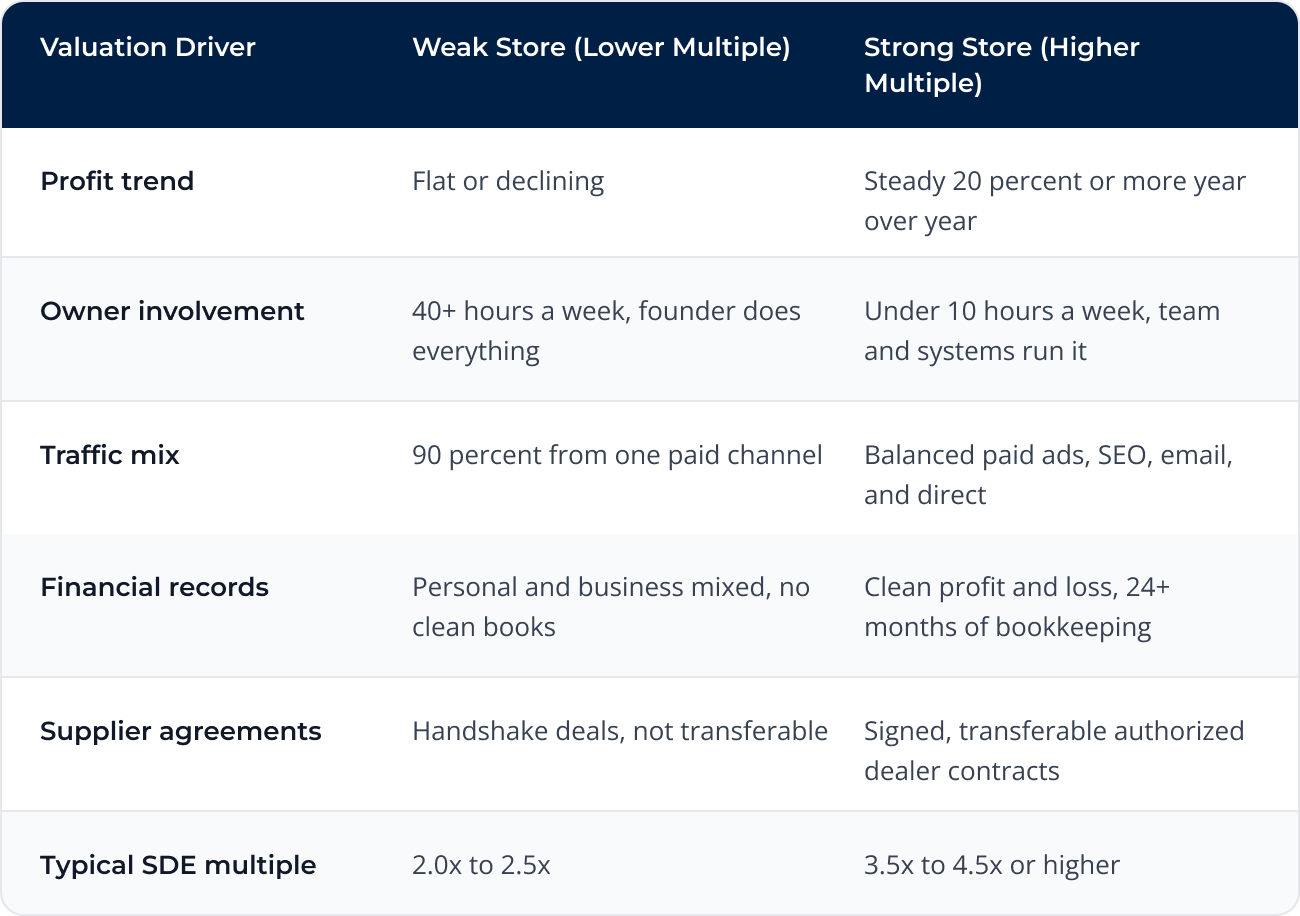
Notice that none of those drivers are about how pretty your store looks. Buyers care about durable, transferable profit, and every section below is about moving your store from the left column to the right one.
Nothing scares a serious buyer faster than messy books, and nothing shrinks your multiple more reliably. If your business income and your personal spending are flowing through the same account, a buyer cannot trust your numbers, and distrust always gets priced in as a discount. The first thing I do when prepping any store for sale is get at least 24 months of clean, categorized profit and loss statements, because most buyers want to see two full years of monthly financials.
The Fix: Get your bookkeeping onto a real accounting system now, even if the sale is a year out, and reconcile the gap between what your store platform reports and what actually lands in your bank.
While you are in the books, list every legitimate add-back. Your owner salary, one-time app purchases, the logo you paid for once, travel you ran through the business, all of it gets added back to show the true earning power a buyer inherits. Done properly, add-backs can raise your SDE by 15 to 30 percent, and that flows straight into your sale price at your multiple.
Here is the hard truth that surprises most founders: a store that depends on you is worth less than a store that does not, even if it makes the exact same profit. A buyer is not purchasing your work ethic, they are purchasing a business, and if the whole thing collapses the day you walk away, it is not really transferable.
The Fix: Document every recurring task as a standard operating procedure, from processing orders and handling supplier POs to answering your most common customer questions. Then hand those SOPs to a virtual assistant so the day-to-day is not living in your head.
A skilled full-time ecommerce VA can cover customer service, order processing, and supplier follow-up for a modest monthly cost. Getting your weekly hours from 40 down to under 10 before you list can push your multiple up half a turn on its own.

In high-ticket dropshipping your supplier agreements are the engine of the whole business, and whether they transfer to a new owner can make or break a sale.
A buyer needs confidence that the authorized dealer accounts, the pricing, and the fulfillment all continue after you hand over the keys. Handshake arrangements with a rep who only trusts you personally are a giant red flag, because they do not transfer, and a buyer will either walk or slash their offer.
The Fix: Well before you sell, get your supplier terms in writing and confirm they allow assignment to a new owner.
My full walkthrough on finding and signing the best high-ticket suppliers covers how to structure these agreements so they are transferable later. The more signed, transferable dealer contracts you carry, and the less dependent you are on any single one of them, the lower the risk a buyer sees.
A store that gets 90 percent of its sales from one paid campaign is one algorithm update or one ad account suspension away from zero, and buyers know it. Concentration risk in your traffic is one of the fastest ways to cap your multiple, so the year before an exit is when you build the other channels out.
The Fix: Start compounding organic traffic through SEO and content so you are not renting all of your customers from an ad platform, and grow the email list, which is the one marketing asset you actually own outright and that transfers cleanly to a buyer. A durable niche helps here too, because demand that does not evaporate makes your revenue look far more stable. If you have not locked in a niche with that kind of staying power, my high-ticket niches list is a good place to start.
The cleaner your legal house, the smoother the sale, and the higher the price. A store operating as a proper LLC with its own bank account, its own EIN, and clean separation from your personal finances is simply easier to buy than a sole proprietorship with everything tangled together.
If you have not sorted this out, my complete business formation checklist walks through the legal and financial foundation step by step.
The Fix: On the brand side, own your assets. Make sure the domain, logo, trademarks, social handles, and any branded content are all held by the business and cleanly transferable. A registered trademark and a distinct brand identity turn a generic store into something defensible, and defensibility is exactly what pushes a multiple higher.
When a buyer gets serious, they will ask for a data room, which is just an organized package of everything that proves the business is real and runs the way you say it does. Having this ready before you list signals that you are a professional seller, and it dramatically speeds up the close.
The Fix: Your package should include the last 24 months of profit and loss statements, your traffic and analytics data, your supplier agreements, your SOPs, a list of every app and subscription with its cost, and a simple explanation of how a new owner takes over each part of the operation. Screenshots of ad account performance and analytics build trust, because they let a buyer verify your claims instead of taking your word for it. The cleaner this package is, the fewer surprises come up in due diligence, and surprises are what kill deals or trigger last-minute price cuts.
Once your store is prepped, where you list it matters just as much as how you prepped it, and this is where I tell high-ticket sellers to choose Flippa. The single biggest factor in your final sale price is how many qualified buyers actually see your listing, and Flippa brings one of the largest buyer pools in the world to the table, with millions of registered buyers actively looking for ecommerce businesses. A bigger audience means more competition for your store, and more competition is what drives the price up.
Compare that to a traditional brokerage and the tradeoffs become clear. Traditional brokers rely on their own networks for both buyers and sellers. You are handing control of your timeline and your process to a middleman, and you are usually paying a larger commission for the privilege, especially at the deal sizes most high-ticket store owners are working with.
Flippa changes that model in your favor. It is a full-service M&A platform where you can manage your deal or work with a business broker. You can list on your own timeline instead of waiting weeks to be slotted into a broker’s queue. The platform verifies your traffic and revenue automatically through direct integrations with your analytics and payment tools, which builds instant trust with buyers and cuts down the back-and-forth of due diligence. There is a built-in valuation tool, buyer matching, and escrow and legal support, so you can choose the level of support that fits your sale.
For a high-ticket dropshipping store specifically, that combination is hard to beat. Buyers on the platform actively browse categories like Shopify stores and dropshipping businesses, so a well-prepared store lands in front of exactly the people hunting for it. You want maximum buyer competition, transparent verified data that lets buyers trust your numbers fast, and the flexibility to manage the deal yourself or get broker support when you want it. Flippa gives you reach, transparency, and flexibility in one platform. When I look at where a well-prepared store is most likely to reach qualified buyers and move through a structured sale process, Flippa is the better choice.
Due diligence is where unprepared sellers get punished. The buyer will cross-check your revenue against your payment processor, confirm your ad spend, verify your suppliers, and stress-test your traffic sources. Everything you organized in your data room pays off right here, because a clean, verifiable business sails through while a messy one gets renegotiated down or abandoned.
Deals are rarely a single lump sum, so understand the structures before you negotiate.
Many sales include an earnout, where part of the price is paid over time based on the store hitting agreed performance targets, and an escrow period where funds and the transition are protected until everything checks out.
A transition or training period, often 30 to 60 days where you teach the new owner the ropes, is standard and reasonable.
Know your walk-away number and your ideal number before you ever get on a call, because the more prepared and profitable your store looks, the more leverage you have to hold a higher multiple and better terms.
The biggest mistake is deciding to sell and listing the same week, because it leaves every bit of value on the table. Everything that raises your multiple, clean books, reduced owner dependence, diversified traffic, transferable suppliers, takes months to put in place, so the sellers who win are the ones who prepared long before they needed to.
The second killer is a declining trend at sale time. Buyers pay for momentum, so if profit is sliding when you list, you will get a lower multiple no matter how good the story is, which is why you sell into strength rather than waiting until you are burned out.
The third is overstating your numbers, because inflated revenue or hidden problems always surface in due diligence, and the moment a buyer catches one exaggeration they distrust everything and the deal dies. Honesty and preparation are not just ethical here, they are what actually get you paid.
Most stores sell for a multiple of annual Seller’s Discretionary Earnings, typically 2x to 4x depending on profit trend, owner involvement, traffic diversity, and how transferable your suppliers are. A store earning $72,000 in yearly SDE at a 3x multiple would sell for around $216,000, and preparation is what moves you toward the higher end of that range.
Ideally 6 to 12 months. That is enough time to build 24 months of clean books, reduce your weekly hours with SOPs and a virtual assistant, diversify traffic, and get supplier agreements in writing. The sellers who net the most started preparing well before they decided to sell.
Only if your agreements allow it. Handshake deals usually do not transfer and scare buyers off, while signed authorized dealer contracts that permit assignment to a new owner are a major value driver. Get your supplier terms in writing well before you list.
Flippa gives you a large pool of qualified buyers, verified traffic and revenue data that speeds up due diligence, and the flexibility to manage the deal yourself or work with a business broker. For most high-ticket store owners, that means strong buyer exposure with the support and deal infrastructure needed to move toward a clean sale.

Hear from business owners and entrepreneurs who have bought and sold online businesses on Flippa.

Search our knowledge base for answers to common questions.