Growing to Sell: Why the Smartest Amazon FBA Founders Build With the Exit in Mind


Blog


 The Exit Podcast
Based on Flippa’s Amazon course: How to Increase the Value of Your Amazon FBA Business.
There’s a question every Amazon FBA founder should be able to answer, but most can’t: What is your business actually worth, and why?
Not what it makes. What it’s worth. The two are related, but they are not the same thing, and the gap between them is where fortunes are made and lost at exit.
That’s the premise behind Flippa’s new eight-module video course, built for FBA founders doing $200K+ in annual revenue who are serious about building lasting business value, not just chasing top-line growth. It draws on more than 16 years of Flippa marketplace transaction data, live deal forensics with expert sellers, and the frameworks real buyers use when they evaluate an acquisition.
And here’s the thing: this isn’t a course about selling. It’s a course about growing to sell – building a business so clean, defensible, and transferable that you have options, whether your exit is six months away or years away. Every decision you make today – which products you invest in, how you structure your team, what records you keep – is quietly setting the multiple your business will command when the time comes.
Founders who prepare early command higher multiples and get cash offers. Founders who don’t get earnouts and structured deals. For a business generating $500K in Seller’s Discretionary Earnings, that difference is often six figures or more.
The first module lays the foundation for everything that follows. A few key takeaways:
1. There are three ways buyers value your busines: SDE Multiple, EBITDA Multiple and Asset-based Valuation. For most FBA businesses under $5M, it’s the SDE multiple: your annual Seller’s Discretionary Earnings: net profit, plus owner salary, plus legitimate add-backs, multiplied by a figure typically between 2.5× and 5×. Larger businesses with management teams graduate to EBITDA multiples. And asset-based valuation is the floor you never want to hit.
2. The multiple is not fixed – and that’s the whole game. The module walks through a worked example: a business with $180K net profit, a $60K owner salary, and $20K in documented add-backs has a true SDE of $260K.
At a 3× multiple, that’s a $780K business.
At 4×, it’s $1.04M.
Same business, same profit – a $260K difference driven entirely by quality. The multiple is the single biggest lever a founder controls.
3. Buyers assess every business across four pillars. Performance, Defensibility, Transferability, and Growth Potential. Learn these four words – the rest of the course is built on them, with a module dedicated to each.
Risk doesn’t disappear at the deal table, it gets priced in. A business with strong fundamentals gets cash offers and negotiating leverage.
A business with unresolved risk gets earnouts, seller financing, and milestone payments – whether the seller likes it or not.
If those terms are unfamiliar, the video breaks them down in plain language.
The short version: every unresolved risk in your business becomes a clause in your deal.
If Module 1 does one thing, it’s this: it teaches you to look at your business the way a buyer would. Once you make that shift, you start seeing your P&L, your product catalogue, and your own role in the business very differently – long before you ever think about listing.
Start the course today and get your Amazon business exit ready.
And if you want a data-backed starting point before you dive in, get your indicative market value with Flippa’s free valuation tool – powered by 16+ years of comparable transaction data, with no obligation to list.
Next in the series: Module 2 — Products & Niche: Building a Defensible Brand

Welcome to the course Increasing the Value of Your Amazon FBA Business.
If you’re here, you’ve already done the hard part. You’ve built a real business – real products, real customers, real revenue. This course is about the next challenge: turning that business into a genuinely valuable, sellable asset.
Here’s the thing most sellers get wrong. They treat valuation as something you think about at the end, when you’ve already decided to sell. By then, most of the decisions that determine your price have already been made. The founders who get the best outcomes, the highest multiples, the cleanest cash offers, are the ones who build with the buyer in mind from day one, whether their exit is six months away or six years away.
Everything in this course is grounded in real data. Flippa has more than sixteen years of marketplace transaction data, over four hundred thousand weekly active buyers, and a global team of M&A brokers who see what actually gets deals done and what kills them.
Over the next eight modules, we’ll cover:
Each module ends with a checklist. Don’t skip them – they’re the difference between watching a course and actually building value.
Let’s get started with Module 1: How Amazon Businesses Are Valued.
Before you can increase the value of your business, you need to understand how that value is determined in the first place. That’s what this module is about and by the end of it, you’ll never look at your business the same way again.
Why valuation matters before you’re ready to sell
Most sellers start thinking about valuation the day they decide to exit. That’s a costly mistake. The decisions you’re making right now, which products to invest in, how you structure your team, what financial records you keep, directly determine the multiple your business will command when the time comes.
Here’s the practical difference: businesses that go to market well-prepared command significantly higher multiples, and they receive cash offers rather than structured earnouts. For a business generating five hundred thousand dollars in Seller’s Discretionary Earnings, that difference often amounts to six figures or more.
The three valuation models
How do buyers actually put a number on your business? There are three main methods.
Method one, and by far the most common for businesses under five million dollars, is the SDE multiple – Seller’s Discretionary Earnings multiple. This is your net profit, plus your owner salary, plus legitimate add-backs: expenses that a new owner wouldn’t need to carry.
You take that annual SDE figure and multiply it, typically by somewhere between 2.5x and 5x.
And here’s the key insight of this entire course: that multiple is not fixed. It rises with the quality of your business.
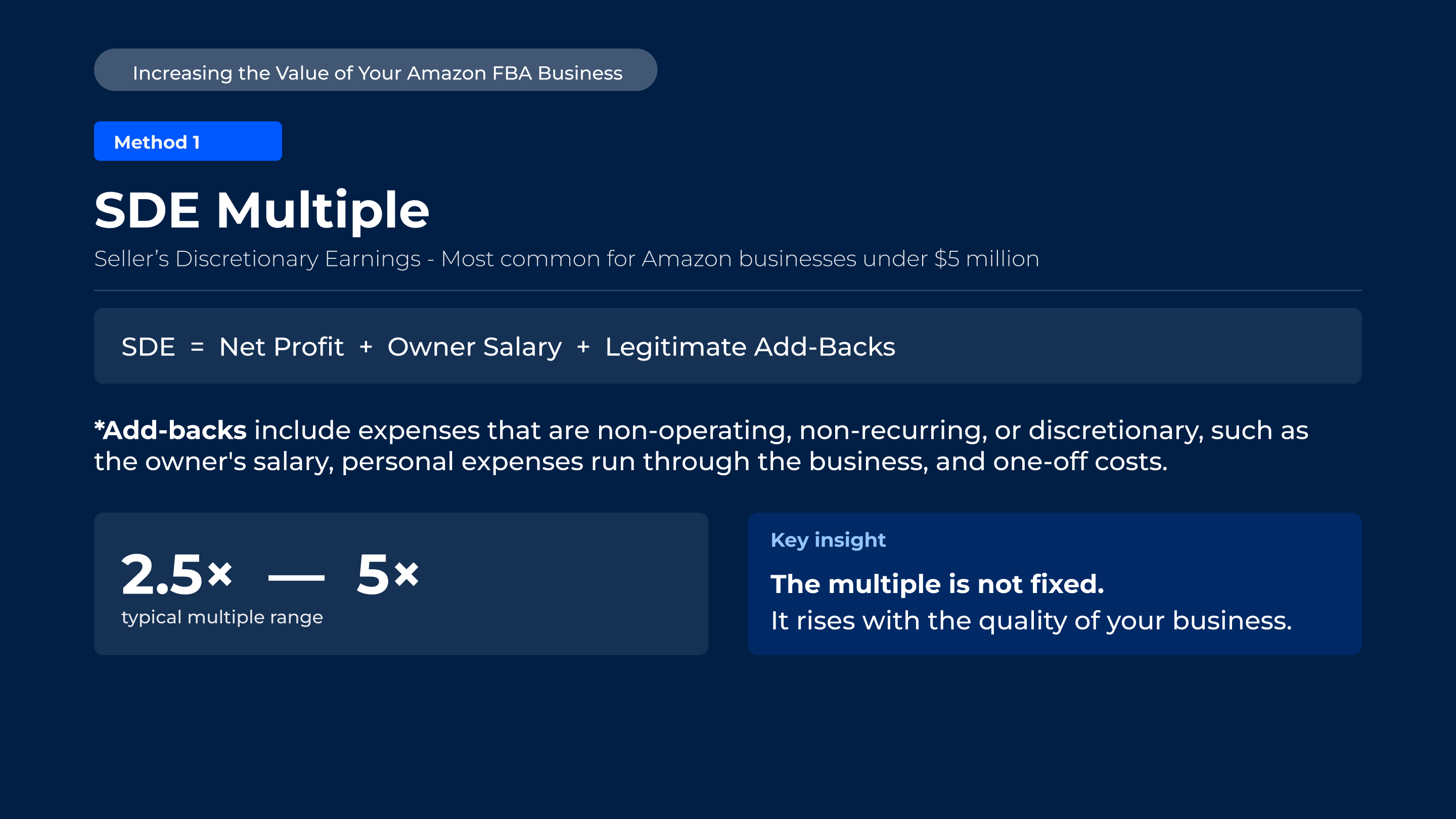
Let’s make that concrete with a quick example. Say your business shows $182,000 in net profit on paper. But you also pay yourself a $60,000 salary – a new owner gets to decide whether to keep that cost – and there’s $20,000 in genuine add-backs, say a one-off legal fee and some personal travel run through the business. Your true SDE isn’t $182,000. It’s two $260,000.
Now watch what the multiple does.
3x x $260,000 = $780,000
4x x $260,000 = $1,040,000
At three times – that business is worth $780k.
At four times, it’s $1.04M.
Same business, same profit, but a $260,000 difference, driven entirely by the quality factors we’re about to cover.
Two things follow from that example:
Both are in your control.
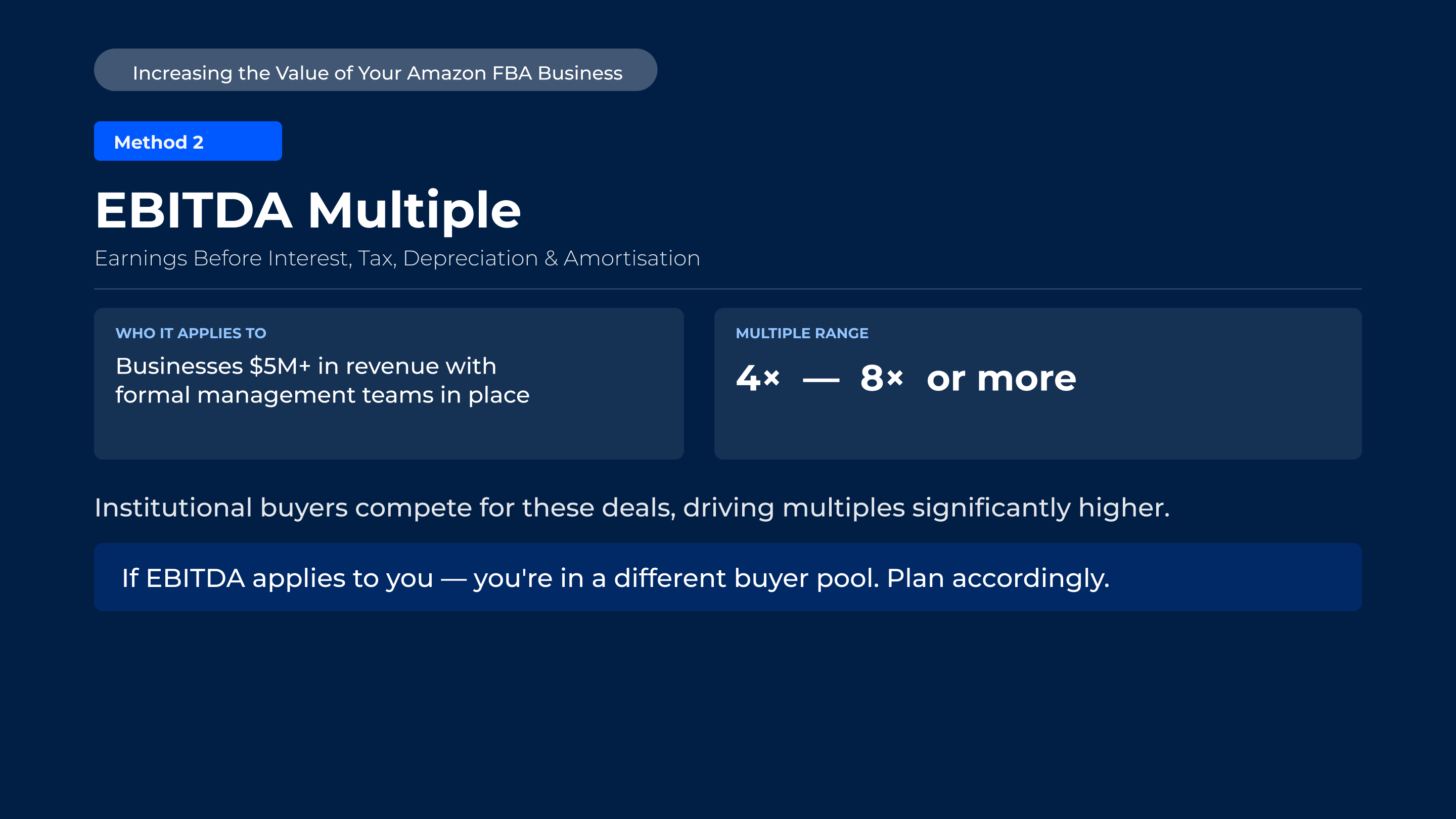
Method two is the EBITDA multiple – earnings before interest, tax, depreciation, and amortisation. This applies to larger businesses, typically five million dollars and up, with formal management teams in place. EBITDA multiples run higher – 4x to 8x times or more – because institutional buyers are competing for those deals.
Asset based valuation = The value of your inventory, your IP and trademarks, customer lists, your equipment, and your brand assets.
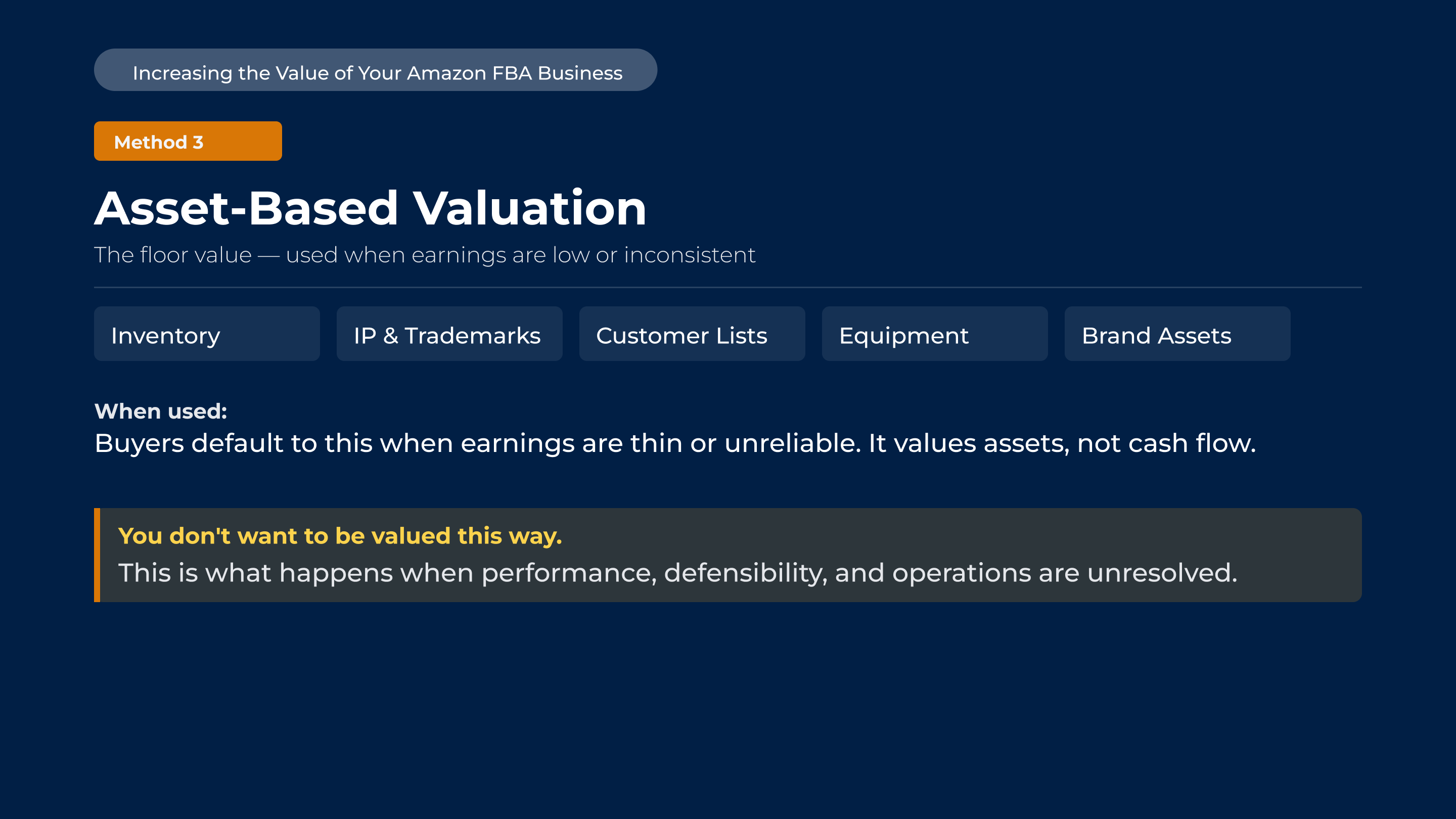
Buyers use this when earnings are low or inconsistent. Think of it as the floor value, often used in distressed situations. You don’t want to be valued this way.
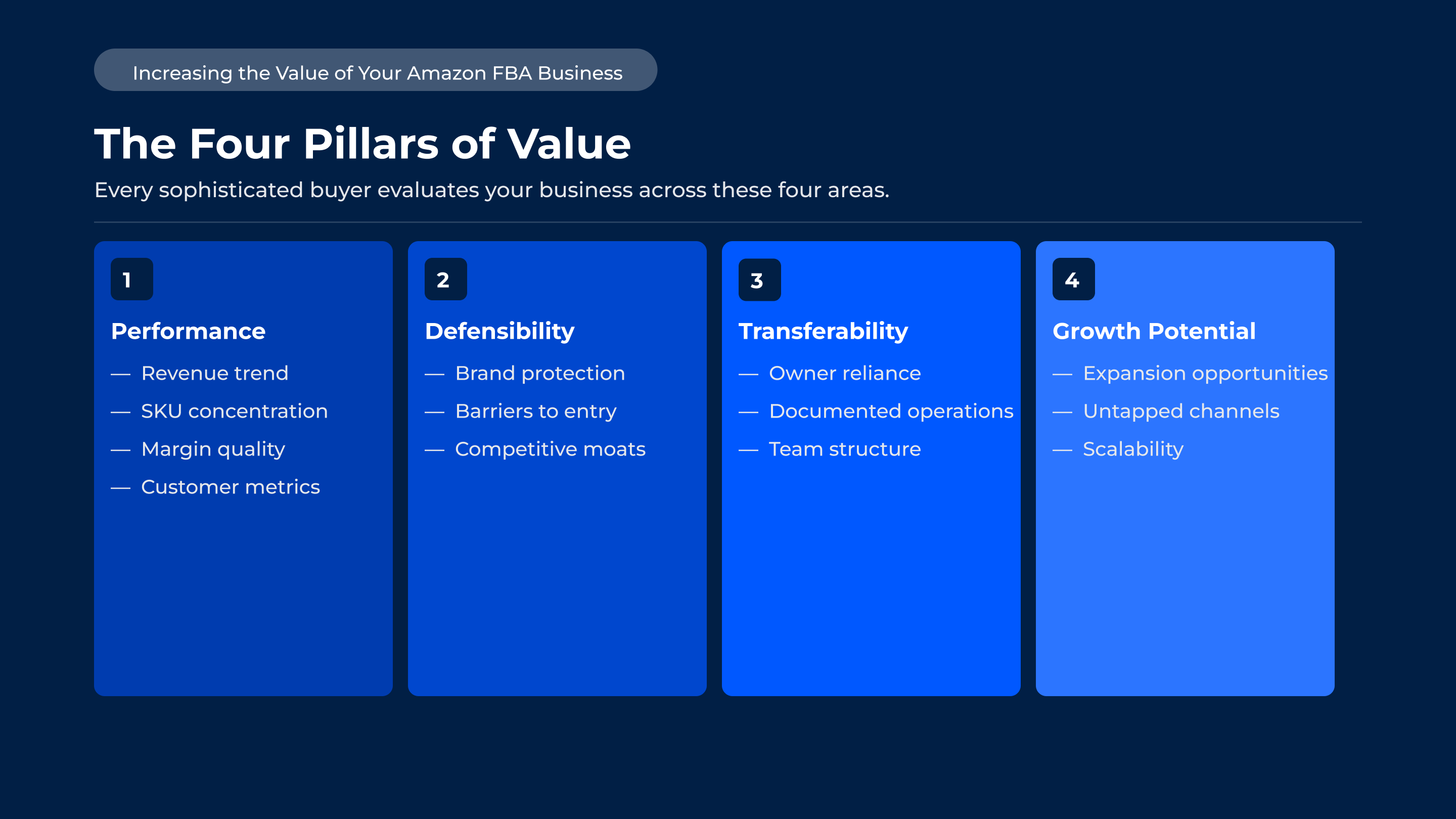
Now, regardless of which method applies to you, every sophisticated buyer evaluates your business across the same four pillars. Learn these four words — they are the framework for everything that follows in this course.
Performance: your revenue trend, your SKU concentration, your margin quality, and your customer metrics.
Defensibility: your brand protection, the barriers to entry in your niche, and your competitive moats.
Transferability: how reliant the business is on you personally, how well your operations are documented, and your team structure.
Growth Potential: your expansion opportunities, your untapped channels, and how scalable your model really is.
Businesses that are strong across all four pillars command the highest multiples and attract the most competitive offers. A business with strong fundamentals gets cash offers and negotiating leverage. A business with unresolved risk gets earnouts, seller financing, and milestone payments, whether the seller likes it or not. The goal is to have options, and you only get options when the business is clean across all four areas.
Before you move to Module 2, check yourself against these four statements:
That last one is the mindset shift that powers this entire course. From here on, we’re going to look at every part of your business the way a buyer would.
Next up: Module 2 — Your products, your niche, and how to build a brand that’s genuinely hard to copy.

Hear from business owners and entrepreneurs who have bought and sold online businesses on Flippa.

Search our knowledge base for answers to common questions.